

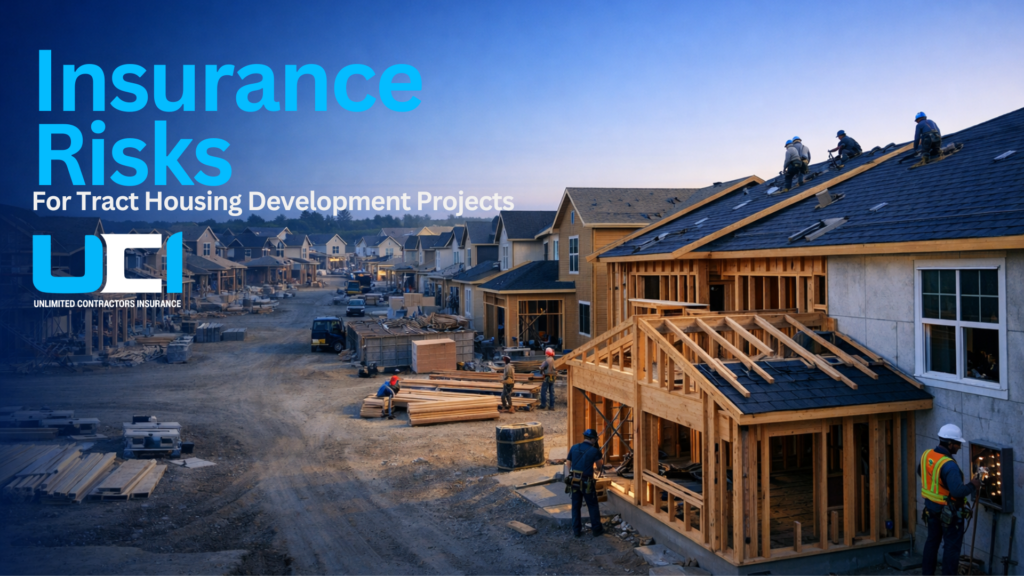
Tract home developments are large-scale residential construction projects where builders construct dozens or even hundreds of homes using the same or similar floor plans across a single community. These projects are designed for efficiency, speed, and consistency, with subcontractors repeating the same scope of work across multiple homes. While this creates steady, scalable work for contractors, it also introduces a very different level of risk—because any issue in one home has the potential to be replicated across the entire development.
Subcontracting in tract home developments can be one of the fastest ways to scale your business. The volume is consistent, the builders are established, and the pipeline of work can stretch across entire communities.
But behind that opportunity is a very different risk environment.
Tract home construction is not the same as custom residential or small commercial jobs. The insurance requirements are stricter, the exposure is significantly higher, and the consequences of getting your coverage wrong can be severe.
If you’re stepping into tract work—or planning to—your insurance needs to be built specifically for it.
What Makes Tract Home Developments Higher Risk
Repetition at Scale Changes Everything
In a standard project, a mistake impacts one job. In a tract development, that same mistake can be repeated across dozens or hundreds of homes.
That’s where the risk multiplies.
A roofing issue, waterproofing failure, or plumbing defect doesn’t stay isolated. It becomes systemic. And systemic issues are what lead to large claims.
Builders understand this, which is why they push strict insurance requirements onto every subcontractor involved.
The Long-Tail Exposure Most Contractors Underestimate
Tract developments don’t just carry risk during construction. They carry risk years after completion.
Construction defect claims can surface long after the project is finished. Homeowners move in, problems appear, and investigations begin.
By that point, multiple trades are pulled into the claim.
Even if your portion of work was small, you can still be included in litigation simply because you were part of the project.
This is why completed operations coverage—and how it’s structured—matters more in tract work than almost anywhere else in construction.
The Reality of Construction Defect and Class Action Claims
One of the biggest challenges insurers face with tract home subcontractors is the combination of scale, repetition, and shared liability across multiple parties. When the same scope of work is performed across dozens or hundreds of homes, even a minor issue can turn into a widespread loss affecting an entire development. At the same time, responsibility is rarely isolated—developers, general contractors, and multiple subcontractors are often all pulled into the same claim, making liability complex and expensive to resolve. This layered exposure, combined with long-term completed operations risk, is exactly why insurers price tract work higher and require stricter policy structures.
Tract home developments are one of the most common environments for construction defect litigation.
When defects appear across multiple homes, claims can escalate quickly.
What starts as a warranty issue can turn into multi-home defect claims, HOA-driven litigation, and multi-party lawsuits involving developers, general contractors, and multiple subcontractors. In more severe cases, these situations can escalate into class action lawsuits.
For subcontractors, this means one thing.
You’re not just insuring your work on one home. You’re insuring your exposure across an entire development.
If your policy isn’t structured correctly, the financial impact can be devastating.
At this level, insurance isn’t about “having a policy.” It’s about whether your policy is built to handle scale, repetition, and long-tail exposure.
Why Insurance Requirements Are So Strict
Developers Are Protecting the Entire Project
Large builders are managing risk at a portfolio level. They’re not just concerned about one subcontractor—they’re concerned about how all trades interact across the project.
That’s why requirements are non-negotiable.
Before you can step onto the jobsite, your insurance typically needs to meet very specific standards tied to both coverage and endorsements.
The Standard Is Higher Than Typical Contractor Work
Compared to standard residential or light commercial jobs, tract development requirements are significantly more detailed.
Most subcontractors will be required to carry general liability with higher limits, but the limits alone aren’t the issue.
The structure of the policy is what matters.
Developers will expect endorsements like additional insured for both ongoing and completed operations, primary and non-contributory wording, waiver of subrogation, and per project aggregate.
If any of these are missing—or incorrectly written—you may not be approved to start work.
Why Tract Work Drives Higher Insurance Costs
Carriers Price Based on Exposure, Not Just Trade
If you’ve ever quoted tract work and noticed your premium increase, there’s a reason.
Insurance carriers evaluate tract developments differently because the exposure is fundamentally different.
Losses in this space tend to be larger in scale, more complex to litigate, more likely to involve multiple parties, and more likely to involve completed operations years later.
Because of this, some carriers limit how much tract work they accept, while others avoid it entirely.
This reduces available markets and naturally drives pricing higher.
Cheap Policies Usually Fail in Tract Environments
One of the biggest mistakes subcontractors make is trying to use a low-cost policy to meet high-level requirements.
In tract developments, this rarely works.
Lower-cost policies often exclude certain types of residential work, limit completed operations, lack required endorsements, or use incorrect class codes.
On paper, you may have insurance. In practice, it won’t meet the builder’s requirements—or worse, it won’t respond properly in a claim.
The Most Common Insurance Mistakes Subcontractors Make
Assuming Existing Coverage Is Enough
A policy that works for smaller jobs may not meet tract requirements. Contractors often assume they’re covered until their certificate is rejected.
At that point, they’re scrambling to fix it while the job is delayed.
Missing Critical Endorsements
Even if limits are correct, missing endorsements like additional insured or primary and non-contributory wording can immediately disqualify your policy.
These are not optional in tract work.
Incorrect or Misaligned Class Codes
If your policy doesn’t accurately reflect the work you’re performing, it can lead to issues both in underwriting and in claims.
This becomes even more important in higher-risk trades like roofing, framing, and waterproofing.
Not Understanding Contractual Risk Transfer
In many tract agreements, subcontractors take on additional liability through indemnification clauses.
If your insurance isn’t aligned with those contracts, you could be assuming risk your policy doesn’t fully cover.

How to Properly Structure Insurance for Tract Work
Start With the Requirements Before You Bid
One of the smartest moves you can make is reviewing insurance requirements before submitting a bid.
This allows you to price the job correctly, structure your policy in advance, and avoid delays once awarded.
Too many contractors win the job first and try to fix insurance after. That approach often leads to lost time and lost opportunities.
Work With Carriers That Understand Tract Exposure
Not all insurance carriers are built for this type of work.
You need access to markets that accept tract home exposure, understand completed operations risk, can issue proper endorsements quickly, and can scale with your business as your volume grows.
Build a Policy That Matches the Job, Not the Minimum
Meeting minimum requirements is not always enough.
Your policy should reflect the size of the development, the number of homes involved, the type of work you’re performing, and the potential downstream exposure.
Because when claims happen, they don’t follow minimums.
At this stage, having your policy reviewed before bidding can prevent delays, rework, or lost contracts later on:
Subcontractors Carry More Risk Than They Realize
In tract developments, subcontractors often carry a significant portion of the project’s risk—whether they realize it or not.
You’re not just responsible for your work in isolation. You’re part of a system where multiple trades overlap, and liability can be shared across all of them.
This means your insurance needs to do more than just exist.
It needs to protect you in a complex, multi-party environment where claims can surface years later and involve multiple layers of responsibility.
Get Your Policy Built for Tract Work
If you’re planning to work on tract home developments—or you’re already being asked to meet stricter insurance requirements—it’s critical to get your policy structured correctly before you step onto the jobsite.
At Unlimited Contractors Insurance, we help subcontractors navigate these exact challenges every day. From meeting builder requirements to structuring coverage for long-term protection, we make sure your policy actually works for the jobs you’re taking on.
Don’t Let Insurance Be the Reason You Lose the Job
Tract home developments can open the door to serious growth.
But they also come with higher standards, higher expectations, and higher risk.
The contractors who succeed in this space aren’t just skilled—they’re prepared.
They understand the requirements, structure their insurance properly, and eliminate friction before it costs them an opportunity.
If you’re serious about working in tract developments, your insurance needs to be just as dialed in as your work.