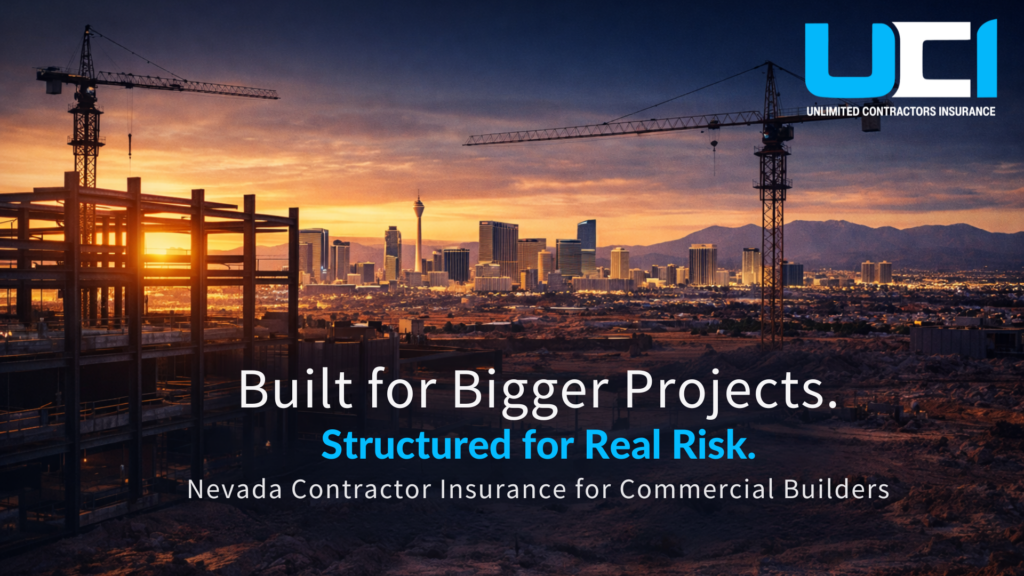
Most contractors in Nevada carry insurance.
Far fewer structure it correctly.
At the commercial level, insurance is not a formality—it is a gatekeeper. It determines whether you can access higher-value projects, satisfy strict contractual requirements, and operate without disruption when something goes wrong.
For builders operating in Nevada’s commercial space, your insurance program is directly tied to your ability to win, execute, and scale.
If your coverage isn’t aligned with your contracts, operations, and risk profile, it will eventually surface—during a claim, a certificate review, or when a project is on the line.
Nevada Is Not a Standard Market
Nevada introduces a unique combination of regulatory requirements and environmental exposure that directly impacts how your insurance should be structured.
You are operating in a market with extreme weather conditions, rapid construction growth, and increasingly strict compliance expectations. High winds, dust, and jobsite volatility increase both liability and property risk. At the same time, contract requirements across commercial builds continue to tighten.
This is where generic coverage fails.
General liability alone is not a strategy. It is a baseline. And in Nevada, baseline is rarely enough.
Insurance Is a Contract Requirement—Not Just Protection
At the commercial level, your insurance is reviewed before your work ever begins.
Contracts often require specific limits, endorsements, and wording structures that must match exactly. If they don’t, you are delayed—or disqualified entirely.
This includes:
- Additional insured endorsements
- Waivers of subrogation
- Primary and non-contributory wording
- Project-specific limits and excess layers
If your policy cannot respond to these requirements immediately, it becomes an operational bottleneck.
The contractors who scale are the ones who eliminate friction here.
General Liability: The Baseline That Gets You in the Door
General liability is the foundation of any contractor insurance program—but on its own, it is incomplete.
At the commercial level, it must be structured to respond to real-world exposures, not just satisfy minimum requirements.
This includes ensuring alignment with:
- Completed operations exposure
- Subcontractor-related risk
- Contractual liability obligations
Without proper structuring, gaps don’t appear during quoting—they appear during claims or certificate reviews, when the cost is significantly higher.
Workers’ Compensation: Protecting Operations at Scale
Workers’ compensation is not just a legal requirement—it is a reflection of how you run your operation.
Injuries on-site are not hypothetical. When they happen, your ability to respond efficiently determines whether the issue remains contained or escalates into financial and operational disruption.
A properly structured workers’ comp program protects your team, stabilizes your operations, and reinforces your credibility with project stakeholders.
At scale, this is non-negotiable.
Commercial Auto: Exposure That Moves With You
Every vehicle in your operation carries liability.
Transporting crews, materials, and equipment introduces constant exposure—especially across multiple job sites and jurisdictions.
Commercial auto coverage must account for:
- Fleet usage patterns
- Driver exposure
- Cross-state operations
This is not just about protection—it’s about continuity. One uncovered incident can halt operations across multiple projects.
Builder’s Risk: Protecting Projects in Motion
Builder’s risk insurance protects what is actively being built.
Fire, theft, weather damage—these are not rare occurrences. Without coverage in place, the financial burden falls directly on you.
This policy ensures that:
- Materials on-site are protected
- Work in progress is covered
- Project timelines are not financially derailed
For commercial builders, this is one of the most critical components of project-level risk management.
Professional Liability: When Execution Meets Expectation
In commercial construction, your exposure is not limited to physical work.
If your input, decisions, or execution result in financial loss for a client, professional liability becomes relevant.
This includes:
- Design-related input
- Project oversight decisions
- Errors or omissions that impact outcomes
At higher contract values, these risks become more visible—and more expensive.
Ignoring this layer is one of the most common blind spots among growing contractors.
Equipment Coverage: Protecting What Drives Production
Your tools and equipment are not incidental—they are operational assets.
The loss, theft, or damage of equipment can delay timelines, increase costs, and disrupt multiple projects simultaneously.
Inland marine coverage ensures that your tools, machinery, and mobile equipment are protected wherever they operate.
Without it, you are self-insuring one of the most critical parts of your business.
Surety Bonds: The Gateway to Larger Projects
At the commercial level, surety bonds are not optional—they are expected.
They signal financial stability, operational reliability, and your ability to complete projects as contracted.
This includes:
- Bid bonds (to secure project opportunities)
- Performance bonds (to guarantee execution)
- Payment bonds (to ensure subcontractor and supplier payment)
Without bonding capacity, your access to larger, more complex projects is limited.
Where Most Contractors Fall Short
The gap is rarely in having insurance.
It is in how that insurance is structured.
Most contractors:
- Fail to update coverage as operations evolve
- Assume general liability is sufficient
- Overpay in low-risk areas while underinsuring critical exposures
This creates imbalance—and that imbalance is where risk lives.
Insurance as a Competitive Advantage
At the UCI level, insurance is not reactive.
It is strategic.
When structured correctly, it allows you to:
- Qualify for higher-value contracts
- Move faster through certificate and compliance reviews
- Build trust with developers, GCs, and project stakeholders
- Operate without interruption when issues arise
This is not about having coverage.
It is about having a system that supports how your business grows.
The Bottom Line
Insurance is not a checkbox.
It is operational infrastructure.
For commercial builders in Nevada, the difference between winning and missing opportunities often comes down to how well your insurance is structured—not whether you have it.
If your current coverage hasn’t been evaluated against your contracts, risk profile, and growth trajectory, it’s worth addressing now.
Request a Review
If you’re operating at—or moving toward—larger commercial projects, your insurance needs to reflect that.
Request a tailored review to ensure your coverage is aligned with how your business actually operates: