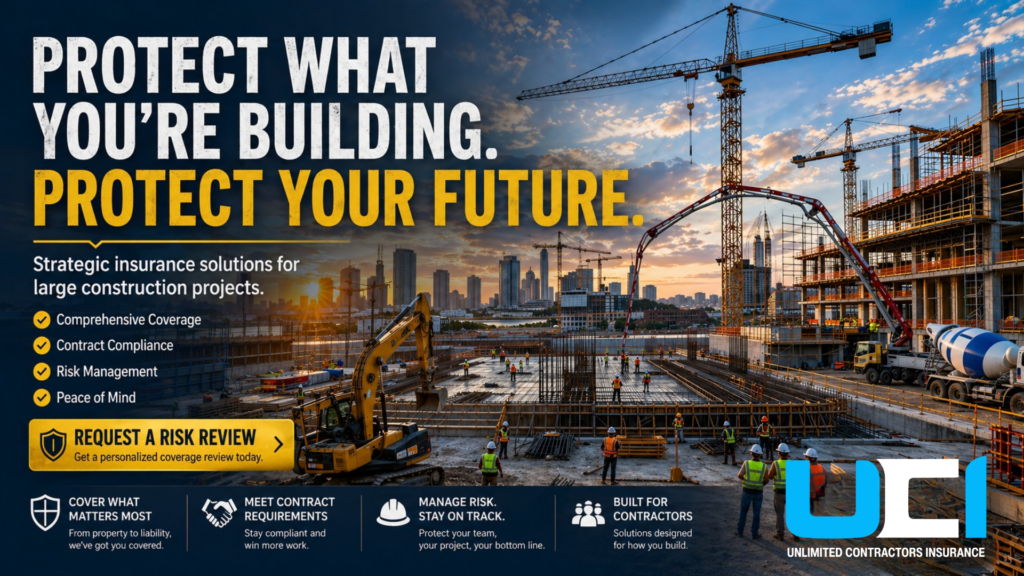
Just as a ship needs a sturdy hull to navigate turbulent waters, your large construction project requires a properly structured insurance framework to withstand real-world risk. At the enterprise level, this isn’t just about having coverage—it’s about making sure it aligns with how your projects actually operate.
Understanding the specific coverages you need is critical, yet many contractors overlook key structural details. Without the right insurance strategy in place, you’re not just exposed to risk—you’re potentially limiting access to larger opportunities.
If you’re unsure whether your current program would hold up under contract review or a major claim, it’s worth reviewing before it’s tested.
Why Construction Insurance Matters for Your Project
When you take on a large construction project, insurance becomes more than a safety net—it becomes part of your operational infrastructure.
It protects against unexpected incidents like accidents, property damage, or delays, while also signaling to developers, partners, and stakeholders that your business is built to operate at scale.
Without properly structured coverage, you risk more than financial loss—you risk project disruption, rejected contracts, and reputational damage. At this level, insurance is directly tied to your ability to win and execute work.
Essential Insurance Types for Large Construction Projects
Having the right insurance coverage is key to safeguarding your project and maintaining credibility at scale. These core coverages form the foundation:
Builder’s Risk Insurance: Covers damage to buildings under construction.
Workers’ Compensation Insurance: Protects employees from work-related injuries.
Automobile Liability Insurance: Covers vehicles used on the job site.
Professional Liability Insurance: Protects against claims of negligence in design or consulting.
The difference isn’t just having these policies—it’s how they’re structured and aligned with your contracts.
General Liability Insurance: Key Coverage Insights
General liability insurance is one of the most scrutinized components on large projects. It protects against bodily injury, property damage, and personal injury claims—but at the enterprise level, that’s only the baseline.
Coverage must align with contract requirements, including endorsements and wording. If it doesn’t, certificates get rejected, and projects stall.
Having properly structured general liability coverage not only protects your business—it reinforces credibility with project owners and partners.
Workers’ Compensation: Essential Protection for Your Team
Construction carries inherent risk, making workers’ compensation a critical safeguard—not just for compliance, but for operational stability.
This coverage supports your workforce through:
Medical expenses for work-related injuries
Wage replacement during recovery
Rehabilitation support
Protection against lawsuits
At scale, the focus shifts from simply having workers’ comp to ensuring payroll, classifications, and subcontractor structures are accurately reflected.
Understanding Professional Liability Insurance Coverage
When a design flaw or oversight leads to delays or financial loss, professional liability insurance becomes essential.
This coverage protects against claims related to errors, omissions, or failure to deliver services as expected. At the enterprise level, it’s not just protection—it’s part of demonstrating accountability and professionalism.
It allows you to operate with confidence in complex projects where design and execution intersect.
Builder’s Risk Insurance: Safeguarding Your Construction Site
Builder’s risk insurance protects your project during construction, covering unexpected events that could derail progress.
Typical coverage includes:
Fire, theft, or vandalism
Weather-related damage
Materials on-site or in transit
Temporary structures
At scale, builder’s risk policies need to reflect the specific project—not a generic template.
Equipment and Tools Insurance: Protecting Your Assets
Your equipment is essential to keeping projects moving. Without proper coverage, loss or damage doesn’t just cost money—it delays operations.
Common protections include:
Inland marine insurance for equipment in transit
Property coverage for on-site tools
Equipment breakdown protection
Rental equipment coverage
A properly structured policy ensures continuity, not just reimbursement.
Environmental Liability Insurance: Mitigating Environmental Risks
Exposure increases with project size. Environmental liability insurance protects against risks that go beyond standard policies.
Coverage typically includes:
Cleanup costs for hazardous materials
Third-party property damage claims
Regulatory fines and penalties
This type of coverage demonstrates responsibility and protects both your business and your reputation.
Surety Bonds: Understanding Their Role in Project Success
Surety bonds play a critical role in large construction projects by guaranteeing that contractual obligations will be met.
They provide assurance to project owners and stakeholders, helping establish trust and financial security. If a contractor fails to perform, the bond ensures the project can still be completed.
At scale, bonding capacity is often directly tied to growth opportunities.
Cyber Liability Insurance for Construction Projects
As construction operations become more digital, cyber liability insurance is increasingly relevant.
It protects against:
Data breaches
Financial losses from cyber incidents
Regulatory compliance risks
Understanding policy exclusions and limits is key to avoiding gaps in protection.
Contractual Insurance Requirements for Your Project
Contract requirements ultimately define what coverage is needed—not just general best practices.
Typical requirements include:
Specific coverage limits
Defined policy types
Project-based protections
Meeting these requirements isn’t optional—it’s what allows projects to move forward without delays.
If your coverage hasn’t been reviewed against your contracts recently, that’s where issues typically surface.
Staying Compliant With Local Construction Insurance Laws
Construction insurance requirements vary by state and jurisdiction, making compliance an ongoing responsibility.
You should:
Stay updated on local regulations
Understand required insurance types
Adjust coverage as projects evolve
Compliance isn’t just about avoiding penalties—it’s about maintaining operational continuity.
The Importance of Insurance Certificates in Construction
Insurance certificates (COIs) are more than documentation—they are often the final approval step before work begins.
They:
Confirm coverage is in place
Help manage risk across stakeholders
Ensure contractual compliance
At the enterprise level, COIs must accurately reflect policy structure—not just existence of coverage.
Top Mistakes to Avoid in Construction Insurance
Even experienced contractors run into issues that impact projects:
Inadequate coverage limits for project scale
Misalignment between policy and contract requirements
Overlooking subcontractor exposure
Failing to update coverage as operations grow
These mistakes don’t just create risk—they can cost opportunities.
Best Practices for Managing Your Insurance Requirements
Managing insurance effectively requires a proactive approach:
Maintain a detailed coverage checklist
Regularly review policies as projects evolve
Communicate requirements across your team
Work with specialists who understand contractor risk
At scale, insurance should be managed as part of operations—not treated as a one-time setup.
Conclusion
In large construction projects, insurance isn’t just a requirement—it’s a strategic advantage.
When structured correctly, it protects your business, supports your team, and enables access to better opportunities. When it’s not, it becomes a limitation.
The difference comes down to alignment.
Before your coverage is tested by a claim or a contract, it’s worth making sure it actually works.