Most contractors will go their entire careers operating within standard insurance frameworks.
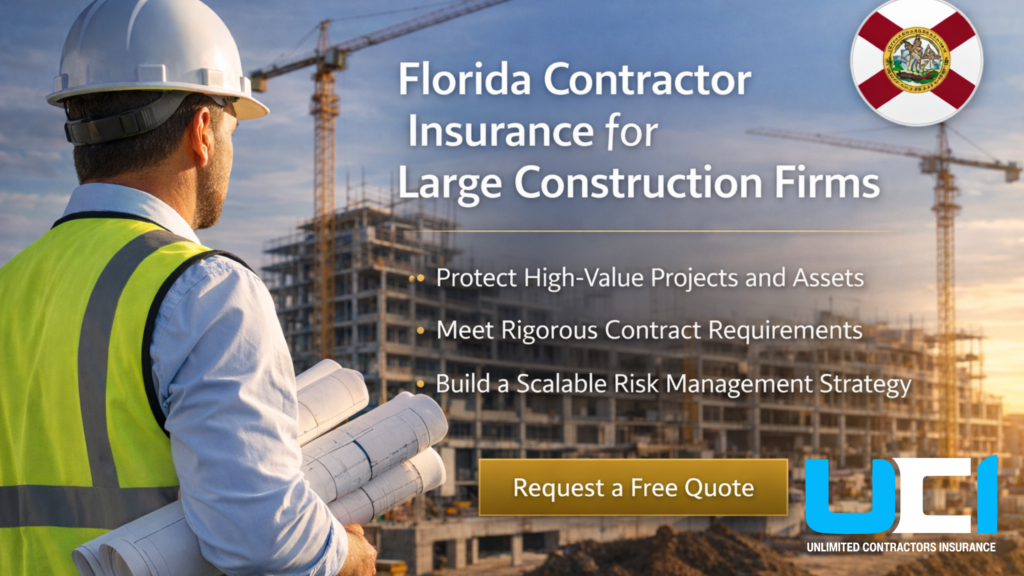
But when you’re running a large construction firm in Florida, you’re no longer operating at a standard level. You’re managing layered exposure across multiple job sites, navigating strict contractual requirements, and carrying financial risk that compounds with every project you take on.
At that level, contractor insurance stops being a simple requirement and becomes a core part of how your business operates. It’s no longer just about protection after something goes wrong. It’s about designing a structure that allows you to take on larger opportunities with confidence, maintain compliance, and protect the long-term stability of your firm.
What Contractor Insurance Really Means at Scale
At its foundation, contractor insurance protects your business from liability, property damage, workforce exposure, and operational risk.
But for large construction firms, the role of insurance expands far beyond basic protection. It becomes the system that allows you to operate without hesitation.
When your coverage is structured correctly, you’re not constantly thinking about worst-case scenarios. You’re focused on execution. You’re able to pursue higher-value contracts, meet demanding insurance requirements from developers and project owners, and maintain a level of operational stability that smaller firms struggle to achieve.
This is where most contractors begin to separate. Not by how much work they take on—but by how well their risk is structured behind the scenes.
Why Large Construction Firms Require a Different Insurance Strategy
At scale, the risks don’t just increase—they multiply.
You’re coordinating multiple crews, managing subcontractors, working across timelines that overlap, and operating under contracts that often include strict insurance clauses and endorsement requirements. One gap in coverage doesn’t just create a problem. It creates a chain reaction that can affect timelines, relationships, and revenue.
This is why large construction firms cannot rely on generic, off-the-shelf policies. What’s required is a deliberately structured insurance program that aligns with how your business actually operates.
Firms that treat insurance as a strategic function—rather than a checkbox—are the ones that consistently win larger projects, retain better clients, and scale without unnecessary friction.
Core Coverages That Must Be Structured Correctly
General liability insurance forms the foundation of your coverage, protecting against third-party injury, property damage, and legal exposure tied to your operations.
At a higher level, however, this coverage directly impacts your credibility. Developers and project owners often evaluate your insurance before they evaluate your proposal. The strength of your coverage signals whether you are capable of handling the scale of work you’re pursuing.
Workers’ compensation operates in a similar way. While it ensures your workforce is protected in the event of job-site injuries, it also reflects how your company operates internally. A properly structured workers’ comp program supports workforce stability, reduces long-term claim exposure, and reinforces a culture of safety that directly impacts productivity and retention.
Commercial auto coverage becomes increasingly important as your operations expand. At scale, this is no longer about a few vehicles—it’s about managing fleet-level exposure, ensuring that accidents or downtime do not disrupt project timelines, and maintaining consistency across multiple active sites.
Professional liability coverage protects something less visible, but equally important—your reputation. When you’re operating at a high level, even minor errors or perceived omissions can lead to disputes or claims. This coverage ensures that those situations are contained, allowing you to maintain trust in the market and continue operating without reputational damage.
Builder’s risk insurance focuses on the project itself. It protects materials, work in progress, and financial exposure tied to delays or damage during construction. For large firms, this is critical, because project disruptions don’t just affect one job—they ripple across your entire pipeline.
If your current coverage isn’t structured to account for these layers of exposure, it’s worth reassessing before those gaps become visible at the worst possible time.
Surety Bonds and Access to Larger Opportunities
At a certain point, insurance alone isn’t enough to compete.
Surety bonds act as a financial guarantee that your firm will fulfill contractual obligations.
For large construction firms, this is often what determines whether you can pursue certain projects at all. Many high-value contracts require bonding as a baseline qualification, and without it, opportunities are simply out of reach.
This is where insurance and financial credibility begin to intersect. The stronger your overall structure, the more access you gain to higher-level work.
Florida Compliance and Operational Stability
Florida’s contractor insurance regulations are not optional, and for large firms, they become increasingly complex as operations expand.
Licensing requirements, coverage minimums, and compliance expectations all play a role in how your business is evaluated. Falling out of compliance doesn’t just result in penalties—it can halt projects, damage relationships, and create unnecessary operational friction.
Staying aligned with these requirements ensures that your business continues to move forward without interruption.
Structuring Coverage Around How Your Business Actually Operates
The most common mistake large contractors make is assuming that standard coverage will scale with their business.
It doesn’t.
Your insurance program should reflect your actual operations—your project sizes, your workforce structure, your equipment, and the types of contracts you’re taking on.
When those elements are aligned, your coverage works seamlessly in the background. When they’re not, gaps begin to appear—and those gaps only become visible when something goes wrong.
This is why thoughtful structuring matters. It’s not about having more coverage. It’s about having the right coverage in the right places.
Choosing the Right Insurance Partner
At this level, the difference between providers becomes clear.
Some agencies focus on selling policies. Others focus on understanding how construction businesses operate and building coverage around that reality.
The right partner doesn’t just respond to requests. They anticipate needs, structure coverage proactively, and help position your firm to meet higher-level requirements without friction.
That difference shows up not just in your coverage—but in the opportunities you’re able to pursue.
Managing Costs Without Compromising Protection
Cost control is always part of the conversation, but reducing premiums should never come at the expense of coverage quality.
Well-structured insurance programs reduce cost through efficiency, not limitation. This can include consolidating policies, improving safety performance, and aligning deductibles strategically.
The goal isn’t to spend less.
It’s to spend correctly.
Keeping Your Coverage Aligned as You Scale
As your business grows, your insurance should evolve with it.
Coverage that worked a year ago may no longer reflect your current level of risk. New projects, expanded teams, and larger contracts all introduce variables that need to be accounted for.
Regular reviews, clear communication with your broker, and consistent updates ensure that your coverage continues to support your operations rather than lag behind them.
This is one of the most overlooked areas—and one of the most critical.
Final Perspective
Most contractors think of insurance as protection.
The most successful firms treat it as a strategic asset.
When your coverage is structured correctly, it doesn’t just protect your business—it enables it. It allows you to take on larger projects, meet stricter requirements, and operate with a level of confidence that directly impacts your ability to grow.
That’s what separates firms that plateau from firms that scale.