
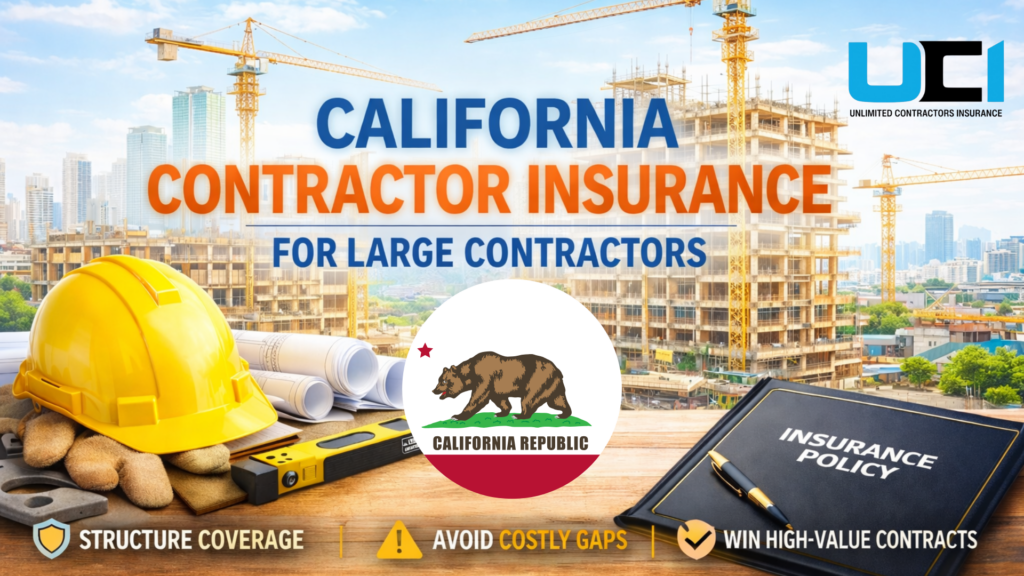
In California, large contractors don’t operate in a standard risk environment.
You’re not just managing projects—you’re navigating layered compliance, high-value contracts, strict insurance requirements, and exposure that compounds with every job site, subcontractor, and signed agreement.
At this level, insurance is no longer a checkbox. It becomes part of your operational infrastructure.
If your coverage isn’t structured correctly, it doesn’t just create risk—it actively limits your ability to win, execute, and scale high-value work.
Why Insurance Becomes a Strategic Lever at Scale
For smaller contractors, insurance is often reactive.
For larger contractors, it’s strategic.
California introduces a unique combination of regulatory pressure, environmental exposure, and contract-driven insurance requirements that make coverage design critical. Between wildfire risk, seismic considerations, labor regulations, and increasingly strict developer requirements, your policy structure directly impacts your ability to operate.
At this level, one misaligned endorsement or missing coverage line can delay projects, invalidate contracts, or expose you to losses that aren’t recoverable.
This is where most generalist insurance approaches start to break.
If you’re operating at scale, your insurance program should be built intentionally around how you actually work—not just what’s cheapest or easiest to place.
If you’re reviewing your current structure, it’s worth stepping back and evaluating whether your coverage is aligned with the type of work you’re taking on. A quick way to do that is by starting with a free quote review:
Core Coverage Structure for Large California Contractors
At a high level, most large contractors carry similar categories of coverage.
What separates strong programs from weak ones isn’t what you have—it’s how it’s structured.
General Liability — More Than a Requirement
General liability is foundational, but at scale, it becomes contract-driven.
You’re not just carrying limits—you’re meeting developer, GC, and project-specific requirements that often include additional insured endorsements, primary & non-contributory language, and completed operations extensions.
If these aren’t aligned correctly before a certificate is issued, you’re not actually compliant—even if you technically “have coverage.”
This is where many contractors run into friction during project onboarding.
Workers’ Compensation — Operational Stability, Not Just Compliance
In California, workers’ compensation isn’t optional—but for larger contractors, it’s also one of the biggest cost drivers in your entire insurance program.
Classification accuracy, subcontractor structuring, and audit exposure all directly impact your bottom line.
Misclassification or uninsured subcontractors can trigger audit surprises that wipe out margins long after the job is complete.
A well-structured workers’ comp program doesn’t just protect your team—it protects your financial predictability.
Professional Liability — Protecting Decisions, Not Just Execution
As project complexity increases, so does exposure to design-related decisions, project oversight, and advisory roles.
Professional liability coverage becomes essential when your work goes beyond execution and into interpretation, coordination, or recommendation.
This is especially relevant for contractors working on design-build projects or coordinating across multiple stakeholders.
The Coverages That Separate Standard Contractors from Scalable Ones
Once you move beyond baseline coverage, the real differentiation begins.
Commercial Auto — Often Overlooked, Frequently Triggered
If your vehicles are tied to operations, they represent a constant exposure point.
Accidents don’t just create repair costs—they create liability chains that can extend into projects, timelines, and contractual obligations.
Commercial auto ensures that a single incident doesn’t ripple across your entire operation.
Inland Marine — Protecting Revenue-Generating Assets
Your tools and equipment aren’t just assets—they’re revenue generators.
Inland marine coverage protects them whether they’re on-site, in transit, or temporarily stored.
Without it, a single theft or damage event can stall operations and delay project delivery.
Umbrella Insurance — Where Real Protection Begins
Standard policy limits get exhausted faster than most contractors expect—especially on larger projects.
Umbrella insurance extends your protection beyond those base limits, creating a buffer between your operations and catastrophic financial exposure.
At scale, this isn’t optional—it’s foundational.
Where Large Contractors Get Exposed (Without Realizing It)
Most insurance failures don’t happen because contractors lack coverage.
They happen because coverage isn’t aligned with operations.
Some of the most common failure points include:
- Subcontractors without proper coverage creating downstream liability
- Missing endorsements that don’t match contract requirements
- Coverage gaps in completed operations
- Policy exclusions that only surface during a claim
- Certificates issued without proper endorsement alignment
These aren’t theoretical risks—they’re operational realities that show up when it’s already too late.
California-Specific Complexity You Can’t Ignore
California isn’t just another state—it’s one of the most complex insurance environments in the country.
You’re dealing with:
- Strict labor laws and wage regulations
- Environmental and wildfire-related exposure
- Seismic risk considerations
- Licensing and compliance requirements
- High litigation frequency
Each of these adds pressure to your insurance structure—and increases the cost of getting it wrong.
Insurance as a Competitive Advantage
At higher levels, insurance becomes part of how you win work.
Developers, general contractors, and project owners don’t just look at your experience—they look at your insurance structure.
If your coverage is clean, aligned, and ready to issue correctly, you move faster.
If it’s not, you create friction—and friction loses deals.
This is why sophisticated contractors treat insurance as part of their positioning, not just their protection.
How to Evaluate If Your Coverage Is Actually Built for Scale
If you’re unsure whether your current program is structured correctly, start with a simple question:
Is your insurance helping you win and execute better projects—or just keeping you compliant?
There’s a difference.
If your coverage hasn’t been reviewed recently—or if it was placed by a generalist—it’s worth taking a second look.
You can start with a free, no-obligation review here:
Final Thought
At a certain level, insurance stops being about protection—and starts being about control.
Control over your risk.
Confidence in your contracts.
The ability to scale without exposure disrupting your operation.
Most contractors only realize this after something goes wrong.
The ones who scale understand it early—and structure accordingly.