

Most contractors treat the work-in-progress schedule as an accounting requirement. Your CPA needs it. Your surety asks for it. You produce it and move on. But in construction WIP schedule underwriting, that document can reveal far more about your business than many contractors realize.
Underwriters read it differently. To them, the WIP is the most revealing document your company produces.
Financial statements show where you ended the year. The WIP shows how you got there, project by project — where margins are holding, where they are slipping, whether you are collecting ahead of your work or falling behind, and whether your estimating is reliable.
Sureties have read WIP schedules this way for decades. Insurance underwriters increasingly do the same on middle-market construction accounts.
This guide explains what the schedule actually says about your business, and what experienced readers look for first.
What a WIP schedule contains
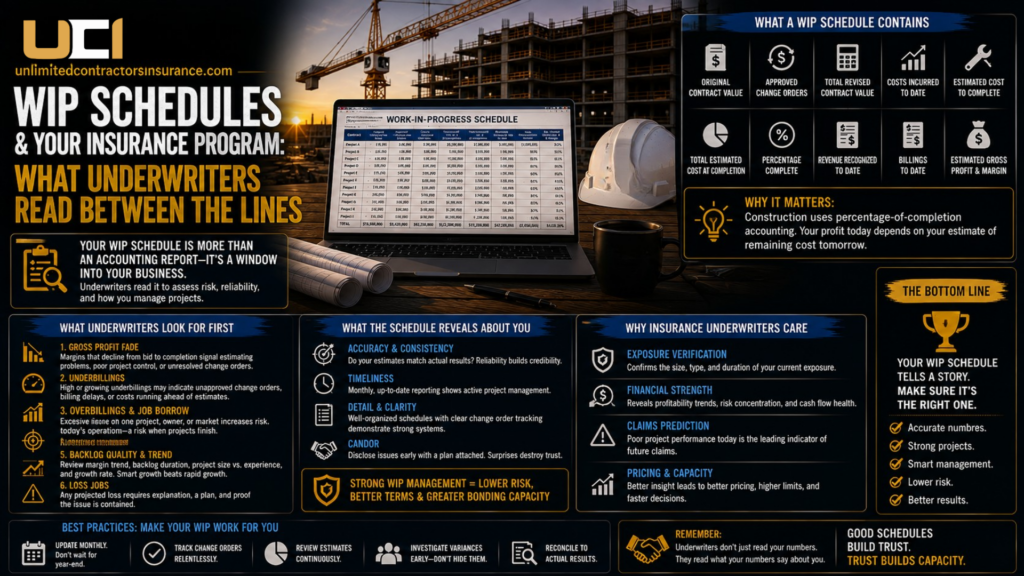
A work-in-progress schedule reports the status of every open contract. Standard columns include:
- Original contract value and approved change orders
- Total revised contract value
- Costs incurred to date
- Estimated cost to complete
- Total estimated cost at completion
- Percentage complete
- Revenue recognized to date
- Billings to date
- Overbillings or underbillings
- Estimated gross profit and margin
The schedule exists because construction uses percentage-of-completion accounting. Revenue is recognized as work progresses, generally measured by costs incurred against total estimated costs.
That method has an important consequence. Your reported revenue and profit depend directly on your estimate of remaining cost. Change that estimate and your reported earnings change immediately.
Underwriters know this. It is precisely why they read the schedule closely.
What underwriters look for first
Gross profit fade
This is the first thing an experienced reader checks, and it reveals more than any other metric.
Fade occurs when a project’s estimated margin declines as work progresses. A job bid at 12% that finishes at 6% has faded by half.
Fade signals estimating problems, poor project control, or unresolved change orders. Consistent fade across multiple projects suggests a systemic issue rather than one difficult job.
The reverse — margins improving late — also draws attention. It can indicate genuine performance, but it can also suggest early estimates were conservative or that costs are being deferred.
What good looks like: margins that hold reasonably steady from bid through completion, with variances explained.
Underbillings
Underbillings, sometimes shown as costs in excess of billings, mean you have performed work you have not yet billed.
Small underbillings are routine. Large or growing underbillings are a warning.
They may indicate unapproved change orders you are performing without authorization, billing delays, disputes with owners, or — most concerning — costs running ahead of your estimate with revenue recognized to match.
Underwriters and sureties discount underbillings heavily when calculating adjusted working capital, because that asset may never convert to cash.
Overbillings and job borrow
Overbillings, or billings in excess of costs, mean you have billed ahead of the work performed. Some overbilling is healthy and improves cash flow.
Excessive overbilling creates a different problem, known as job borrow. You are funding current operations with cash from work you have not yet performed. When those projects finish, the cash stops while the costs continue.
Contractors who fail frequently show heavy overbilling in their final year. Readers watch for it specifically.
Concentration
A schedule dominated by one project, one owner, or one market segment concentrates risk.
If a single job represents a large share of your backlog, its problems become your company’s problems. If one owner accounts for most of your receivables, their payment behavior determines your liquidity.
Diversified backlog reads better than concentrated backlog, even at similar total volume.
Backlog quality and trend
Volume alone says little. Readers examine:
- Margin trend in new work versus completed work. Declining bid margins suggest you are buying jobs to keep crews busy.
- Backlog duration. How many months of work does it represent?
- Project size relative to experience. A job substantially larger than anything you have completed draws scrutiny.
- Growth rate. Backlog growing far faster than your organization is a recognized failure pattern.
Loss jobs
Any project with a projected loss requires explanation. Under percentage-of-completion accounting, an anticipated loss must be recognized in full immediately rather than spread across the remaining work.
Underwriters want to know what happened, whether it is contained, and what changed as a result.
What the schedule reveals about your management
Beyond the numbers, the document itself sends signals.
Accuracy and consistency. Do prior-period schedules reconcile with actual outcomes? A contractor whose estimates prove reliable earns considerable credibility.
Timeliness. Monthly WIP reporting suggests active project control. Annual preparation for the accountant suggests the opposite.
Detail and clarity. Well-organized schedules with clear change order tracking indicate strong systems.
Candor. Problems disclosed early, with a plan attached, build trust. Problems that surface only when unavoidable damage it.
Underwriters form views about management quality, and those views affect pricing and capacity. The WIP is one of the primary places those views form.
Why insurance underwriters care
Sureties have always read WIP schedules. The reason insurance underwriters increasingly request them on larger accounts is more practical.
Exposure verification. Your rating basis depends on payroll and receipts. The WIP shows the actual work driving those figures.
Operational understanding. Project types, sizes, and locations tell an underwriter what you actually do, which affects classification and appetite.
Financial stability. A contractor under financial strain is a worse risk. Distressed contractors cut safety spending, defer maintenance, and take on marginal work.
Growth assessment. Rapid expansion into larger or unfamiliar projects changes the risk profile, and underwriters want to see it before it appears in claims.
Program structure decisions. If you are pursuing a loss-sensitive program or captive, your financial capacity to fund retained losses matters directly. The WIP is central to that evaluation.
Common WIP problems and how to fix them
Unapproved change orders sitting in the schedule. Performing work without written authorization creates underbillings that may never be collected. Fix the change order process, not the schedule.
Optimistic cost-to-complete estimates. Project managers frequently understate remaining costs, which overstates current profit and produces fade later. Independent review of estimates at completion corrects this.
Stale schedules. A WIP prepared once a year cannot support project control. Monthly preparation catches problems while they remain fixable.
Inconsistent methodology. Changing how you measure completion between periods makes comparison impossible and invites questions.
Missing detail. Schedules without change order breakdowns, project descriptions, or start and completion dates give readers less to work with, and less understanding generally means more conservative treatment.
No reconciliation. Your WIP should tie to your financial statements. When it does not, credibility suffers immediately.
How to present it well
The goal is not to make the schedule look better than reality. It is to make reality clear.
Prepare it monthly. This is the highest-value change most contractors can make. Monthly WIP gives you management information and gives underwriters confidence in your systems.
Have a construction-experienced CPA involved. Percentage-of-completion accounting has real subtleties. A generalist accountant may produce a technically correct schedule that presents poorly.
Explain variances proactively. Attach a narrative to any project with meaningful fade, a loss position, or large underbillings. Explaining a problem is far better than having it discovered.
Track change orders rigorously. Approved change orders belong in contract value. Unapproved work belongs in a disclosed, separate category, not buried in underbillings.
Reconcile to your statements. Every time.
Show history. A schedule showing how prior projects actually closed against their estimates demonstrates reliability better than any current-period presentation.
Frequently asked questions
What is a WIP schedule in construction?
A work-in-progress schedule reports the status of all open contracts, including contract value, costs incurred, estimated cost to complete, percentage complete, revenue recognized, billings, and the resulting over- or underbilling position. It supports percentage-of-completion accounting.
Why do sureties and underwriters want my WIP schedule?
Because it shows how your business is performing project by project rather than only where it ended the period. It reveals margin trends, billing discipline, backlog quality, concentration risk, and the reliability of your estimating — all of which affect creditworthiness and risk assessment.
What is gross profit fade?
Fade is the decline in a project’s estimated gross margin as work progresses. It usually signals estimating problems, weak project control, or unresolved change orders. Consistent fade across multiple projects suggests a systemic issue and is one of the first things experienced readers look for.
Are underbillings bad?
Small underbillings are normal. Large or growing underbillings raise concern, because they may represent unapproved change orders, billing delays, disputes, or cost overruns. Sureties commonly discount underbillings when calculating adjusted working capital, since the asset may not convert to cash.
What is job borrow?
Job borrow occurs when a contractor funds current operations using cash collected ahead of work performed, shown as excessive overbillings. It creates a liquidity problem when those projects complete, because the cash inflow stops while costs continue. It is a recognized warning sign of financial distress.
How often should I prepare a WIP schedule?
Monthly. Annual preparation for your accountant provides no management value and signals weak project controls. Monthly reporting catches margin erosion while it can still be addressed and demonstrates operational discipline to sureties and underwriters.
Do insurance underwriters really read WIP schedules?
On middle-market construction accounts, increasingly yes. They use it to verify exposure, understand your actual operations, assess financial stability, evaluate growth, and — where a loss-sensitive program or captive is being considered — judge your capacity to fund retained losses.
How does a loss job get reported?
Under percentage-of-completion accounting, an anticipated loss on a contract is generally recognized in full as soon as it becomes probable, rather than spread across remaining performance. That treatment makes loss jobs highly visible, so expect questions and prepare an explanation.
Treat it as a management document, not a compliance exercise
The contractors who present well to sureties and underwriters are rarely the ones with the best presentation. They are the ones running the business from the same document.
Monthly WIP preparation catches fade while it can be corrected. Rigorous change order tracking prevents underbillings from accumulating. Independent review of cost-to-complete estimates keeps reported margins honest. And a track record of estimates that prove accurate builds credibility no narrative can substitute for.
Everything an underwriter reads between the lines is simply the byproduct of running the business well or poorly.
If you are preparing for a renewal, a surety review, or a program structure decision and want to understand how your WIP will read to an underwriter, that is a conversation worth having before the submission goes out.
This article is general information, not accounting, tax, or legal advice. Accounting standards and their application vary by circumstance. Review your financial reporting with a construction-experienced CPA.