

Most contractors judge their insurance program by one number. They look at the premium, compare it to last year, and decide whether they did well.
That number is incomplete. For a contractor above roughly $1 million in revenue, premium is only one part of what risk actually costs the business. Deductibles, safety spending, claims administration, lost productivity, and missed bid opportunities all cost real money too. Add them together and you get the metric larger contractors actually manage: Total Cost of Risk, or TCOR.
The distinction matters more than it sounds. A contractor can cut premium by 15% and still increase total cost. It happens routinely.
What total cost of risk actually means
Total Cost of Risk is the full financial impact of risk on your business over a period, usually a year.
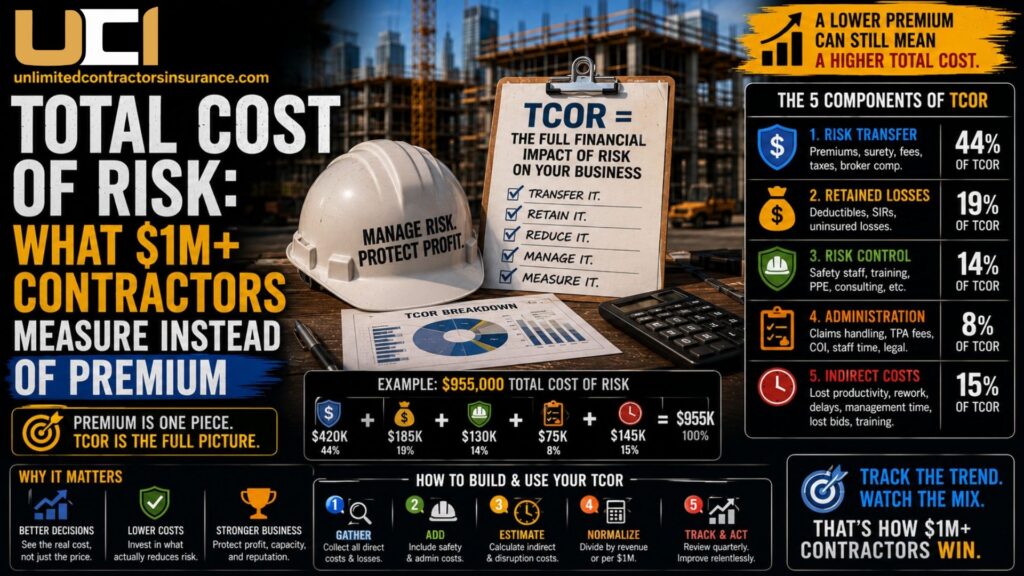
It combines what you pay to transfer risk, what you pay when losses happen, what you spend preventing them, what you spend administering the whole thing, and what the disruption costs you indirectly.
Think of premium as the price of one tool. TCOR is the cost of the entire job.
The five components
| Component | What it includes | Commonly overlooked? |
| Risk transfer | Premiums, surety costs, policy fees, surplus lines taxes, broker compensation | No — this is the number everyone tracks |
| Retained losses | Deductibles, self-insured retentions, uninsured and uncovered losses | Partly |
| Risk control | Safety staff, training, PPE, drug testing, telematics, loss control consulting | Often |
| Administration | Claims handling, TPA fees, COI compliance, risk management staff time, legal and actuarial support | Almost always |
| Indirect costs | Lost productivity, rework, schedule delay, replacement worker training, management time on claims, lost bid eligibility | Almost always |
Notice the pattern. The components contractors track best are the ones they control least. The components they ignore are often the ones they could change tomorrow.
Why premium is a smaller share than you think
Here is an illustrative breakdown for a hypothetical commercial contractor. The figures are made up to show proportion, not to serve as a benchmark.
| Component | Annual cost | Share of TCOR |
| Premiums and surety | $420,000 | 44% |
| Retained losses (deductibles and SIRs) | $185,000 | 19% |
| Risk control and safety | $130,000 | 14% |
| Administration | $75,000 | 8% |
| Indirect and disruption costs | $145,000 | 15% |
| Total | $955,000 | 100% |
In this example, premium accounts for less than half the total. Yet it receives nearly all the attention at renewal.
Now consider what happens if this contractor shops the program and saves $50,000 in premium. That looks like a win. But suppose the cheaper policy carries a higher retention, and losses rise as a result. The savings disappear, and total cost climbs.
That is the central lesson of TCOR. You cannot manage what you do not measure, and premium alone measures very little.
Why this matters more above $1 million in revenue
Smaller contractors have limited control over their cost of risk. They buy guaranteed-cost coverage, pay the premium, and absorb whatever the market charges.
Larger contractors have levers. They can take on retention, invest in safety and see it show up in the experience modification factor. They’re able to control claims rather than letting a carrier drive them. They also, can build subcontractor compliance programs that keep other people’s losses off their books.
In other words, TCOR becomes actionable at scale. Below a certain size it is mostly a description. Above it, it is a management tool.
Three construction-specific costs that hide inside TCOR
Lost bid eligibility. Many owners and general contractors set an experience modification threshold for prequalification. Cross it and you stop getting invited to bid. That is not an insurance cost on any statement, but it is unquestionably a cost of risk — often the largest one.
Reduced bonding capacity. Sureties look at your financials and your loss history. Poor results constrain capacity, which constrains the size and volume of work you can pursue.
Multi-year premium consequences. A claim today affects your experience modification factor across roughly three future rating periods. The cost is not the claim. The cost is the claim plus three years of elevated premium on your entire payroll.
How to calculate your TCOR
Start simple. Precision improves with practice.
Step one: gather the direct numbers. Pull all premiums, surety costs, fees, and taxes for the year. Then pull retained losses from your loss runs, including deductibles and SIRs actually paid.
Step two: add risk control spending. Include safety personnel, training time, equipment, drug testing, telematics subscriptions, and any consulting.
Step three: add administration. Count TPA fees, COI compliance software or staff time, internal risk management hours, and legal or actuarial support.
Step four: estimate indirect costs. This is the hardest bucket and the most important. Estimates of indirect cost vary widely, and no single multiplier fits every business. Rather than guessing at a ratio, track a few concrete items: crew downtime after an incident, rework hours, schedule extension costs, and management hours spent on claims.
Step five: normalize it. Divide TCOR by revenue, or express it as TCOR per $1 million of revenue.
That last step is essential. A growing contractor will see absolute TCOR rise every year. Normalizing tells you whether your cost of risk is actually improving relative to the business.
What to do with the number
A single year’s TCOR tells you very little. The value comes from trend and composition.
Track it quarterly. Annual review is too slow to change anything.
Watch the mix, not just the total. If retained losses are climbing while premium falls, your program is shifting cost rather than reducing it.
Stratify your losses. Break claims down by line of coverage, cause, project type, and crew. Most contractors find their losses concentrate far more narrowly than they expected. New-hire injuries are a common concentration point, and one that responds well to onboarding and acclimatization changes.
Report it to ownership. TCOR is a finance metric. It belongs in the same conversation as gross margin and working capital, not in a folder your agent opens once a year.
How larger contractors actually reduce TCOR
Here is where the metric earns its keep. Each lever below reduces total cost without reducing protection.
Reduce frequency, not just severity
Experience rating formulas generally weight the primary portion of each claim heavily and discount the excess portion. As a result, several small claims damage your modification factor more than one large claim of the same total value.
Most contractors focus on preventing catastrophic events. Meanwhile, a steady trickle of minor injuries quietly drives their premium.
Keep claims medical-only
A structured return-to-work program keeps injured workers productive on modified duty. In many states, medical-only claims count at a substantially reduced value in experience rating. Claims also close faster, and litigation becomes far less likely.
Few investments in construction return as reliably.
Control claims instead of observing them
Larger contractors review loss runs quarterly. They push carriers to close resolved claims and correct inflated reserves. They verify the experience modification worksheet for errors, which are more common than most owners assume.
An open claim is valued at whatever the carrier reserved, not what it will ultimately cost. Stale reserves inflate your modification factor for years.
Move loss off your program through contract
Proper contractual risk transfer keeps other parties’ losses where they belong. That means written subcontracts before mobilization, additional insured endorsements rather than certificates, primary and non-contributory wording, and waivers of subrogation.
It also means enforcement. Tie subcontractor compliance to site access and payment, or the requirements will be ignored.
Prevent audit surprises
Payments to subcontractors you cannot document as insured typically get charged to you as your own payroll at audit. Invoices that fail to separate labor from materials can pull the full amount into your rating basis.
Both are administrative problems with direct premium consequences. Both are fixable.
Consider structural change once frequency is controlled
Loss-sensitive programs, large deductibles, and group captives can meaningfully reduce cost. However, they reward contractors who have already established claims discipline and punish those who have not.
Fix the frequency first. Then change the structure.
The trap: cutting premium and raising TCOR
Several common cost-cutting moves increase total cost. Watch for these.
- Lowering limits. The premium saving is usually small. The gap in a serious claim is not.
- Buying a cheaper policy with broader exclusions. An employee injury exclusion or a residential exclusion can leave your most likely claim uncovered.
- Cutting safety spending. Frequency rises, the modification factor follows, and premium increases for years afterward.
- Deferring COI compliance. You inherit audit charges and other people’s claims.
- Taking a retention you cannot fund. Especially where a frequency peril can recur within a few seasons.
Each of these lowers the number on the invoice. Each raises the number that actually matters.
Who should own this
TCOR sits with finance, supported by operations.
Your CFO or controller should own the calculation and the reporting. Operations should own the risk control and claims response that move it. Your broker should supply the data and the benchmarking.
If nobody owns it, it does not get measured. And if it does not get measured, your insurance program gets managed by whoever quotes the lowest premium in November.
Frequently asked questions
What is total cost of risk?
Total Cost of Risk is the full annual financial impact of risk on a business. It combines risk transfer costs such as premiums, retained losses such as deductibles, risk control spending, administrative costs, and indirect costs like lost productivity and schedule delay.
How do you calculate TCOR?
Add your premiums and fees, your retained losses, your risk control spending, your administrative costs, and your estimated indirect costs. Then divide by revenue to normalize the figure. Tracking TCOR per $1 million of revenue lets you compare performance year over year as the business grows.
Is TCOR the same as my insurance premium?
No. Premium is one component. For many larger contractors it represents less than half of total cost of risk, which is why managing premium alone often fails to reduce what risk actually costs.
What is a good TCOR benchmark?
There is no universal benchmark. Cost of risk varies widely by trade, geography, project type, and program structure. The useful comparison is your own trend over time, normalized to revenue, alongside peer data your broker can supply for genuinely comparable operations.
Why does TCOR matter more for larger contractors?
Because larger contractors have levers. They can take on retention, invest in safety, control claims, and build subcontractor compliance programs. Smaller contractors buying guaranteed-cost coverage have far less influence over their total cost.
How does the experience modification factor affect total cost of risk?
It affects TCOR twice, multiplies workers’ compensation premium across roughly three future rating periods. It can also gate pre-qualification with owners and general contractors who set modification thresholds, which turns a claims problem into a lost revenue problem.
Can lowering my premium actually increase my total cost of risk?
Yes, and it happens often. Reducing limits, accepting broader exclusions, cutting safety investment, or taking a retention you cannot fund all lower premium while raising total cost.
Who should own TCOR in a construction company?
Finance should own the measurement and reporting, with operations owning the safety and claims practices that move it. Your broker supplies data and benchmarking. Without clear ownership, the metric goes untracked.
Measure the whole cost, then manage it
Premium is the easiest number to find and the least useful one to optimize. It tells you what one carrier charged for one year. It says nothing about whether your business is getting better at managing risk.
Total Cost of Risk answers that question. It also points directly at the levers — frequency, claims discipline, contractual transfer, compliance, and program structure — that larger contractors use to reduce cost without reducing protection.
Most contractors above $1 million in revenue have never had their full cost of risk calculated. It is usually a revealing exercise, and it almost always identifies costs that were invisible before.
If you would like help building your TCOR baseline and identifying where the recoverable cost sits, that is a straightforward place to start.
United Contractors Insurance works with larger contractors and commercial operations on program design, loss-sensitive and captive structures, claims advocacy, and contractual risk transfer. Request a total cost of risk analysis and we will build the baseline with you.
This article is general information, not legal, accounting, or actuarial advice. Rating rules and program structures vary by state and carrier. Confirm specifics with your advisors.