

On a straightforward project, builders risk is a simple product. Insure the structure, insure the materials, cover the usual perils, done.
On a complex project, it becomes one of the most negotiated placements in the program — and the negotiations that matter most are not about limits or premium.
They are about three things. Which defect exclusion wording applies. Whether soft costs are covered. And whether delayed completion triggers financial protection at all.
Get those three right and the policy responds to what actually goes wrong on large projects. Get them wrong and you hold a policy that pays for the physical damage while leaving the larger financial loss uninsured.
Why complex projects need a different approach
Complexity changes the risk profile in specific ways.
Long durations mean more exposure and more chance the market shifts mid-project. Multi-year schedules interact awkwardly with annual aggregates. Testing and commissioning create a distinct high-risk phase most policies treat separately. Engineered systems introduce design and workmanship exposure that standard forms handle poorly.
Most importantly, the financial consequence of a delay frequently exceeds the physical damage that caused it. A failure that costs $2 million to repair can cost far more in extended financing, lost revenue, and liquidated damages.
Standard builders risk pays the $2 million. Whether it pays the rest depends entirely on how the policy was structured.
The defect exclusion question
Every builders risk policy excludes something related to defective design, materials, or workmanship. The question is how much.
This is the single most consequential coverage decision on an engineered project, and it turns on which wording the policy uses.
The LEG clauses
The London Engineering Group developed three standard defect wordings, and they have become the reference point in the market.
| Clause | What it excludes | Practical effect |
| LEG 1 | All loss or damage arising from a defect | Most restrictive — no coverage for defect-related damage, including resulting damage |
| LEG 2 | The cost that would have been incurred to rectify the defect immediately before the damage occurred | Resulting damage covered; the cost of fixing the defect itself excluded |
| LEG 3 | Only the cost of improvement to the original design, material, or workmanship | Broadest — covers resulting damage and much of the rectification cost |
The practical difference is substantial.
Consider a defective weld that fails and causes a structural collapse. Under LEG 1, the entire loss is likely excluded because it arose from a defect. In LEG 2, the collapse damage is covered, but the cost of properly making that weld is not. Under LEG 3, most of the loss is covered, excluding only the cost of improving the original work beyond its intended standard.
LEG 2 is the most common market position, LEG 3 is available on well-engineered projects with strong quality control, and it is worth pursuing on complex work. LEG 1 should generally be resisted.
A related family, the DE clauses (DE1 through DE5), serves a similar function and appears more often on marine, offshore, and certain international placements. DE5 is the broadest.
Why this matters more than limits
Contractors negotiate limits hard and accept defect wording as boilerplate. That is backwards.
On an engineered project, defect-related failures are among the most likely large losses. The difference between LEG 1 and LEG 3 can determine whether a major claim pays at all.
Ask which wording your policy contains. If the answer is unclear, that itself is a problem.
Soft costs: the loss beyond the damage
When a covered loss delays a project, the physical repair is only part of the cost.
Soft costs coverage addresses the additional expenses a delay creates. Typically covered items include:
- Additional loan interest and financing charges
- Extended architectural, engineering, and consulting fees
- Extended general conditions and site supervision
- Additional legal and accounting expenses
- Insurance and permit extension costs
- Re-leasing or re-marketing expenses
- Additional real estate taxes during the extension
- Liquidated damages, on some forms
Soft costs coverage is not automatic. It must be endorsed, and the limit must be sized deliberately.
On a large project with substantial construction financing, extended interest alone can dwarf the repair cost. That makes soft costs one of the highest-value endorsements available.
Delay in start-up: the owner’s business income
Delay in start-up coverage, often called DSU or delayed opening coverage, addresses a different loss.
Where soft costs cover additional expenses, DSU covers lost income — the revenue the completed project would have generated during the delay period.
This matters most on income-producing assets. A hotel, apartment community, retail center, data center, or industrial facility generates revenue from the day it opens. A six-month delay is six months of lost income.
DSU is typically purchased by the owner rather than the contractor, though contractors should understand it for two reasons. First, projects carrying DSU tend to have owners who are highly focused on schedule, which shapes contract terms and liquidated damages. Second, when a delay occurs, a DSU carrier that pays a large claim may pursue recovery from whoever caused it.
The waiting period
Both soft costs and DSU coverage use a waiting period rather than a dollar deductible. A defined number of days must elapse before benefits begin.
This deserves careful attention. A waiting period longer than a typical delay renders the coverage largely decorative. Contractors and owners sometimes extend the waiting period to reduce premium, then discover that most realistic delays fall entirely within it.
Size the waiting period against realistic delay scenarios, not against the premium saving.
Testing and commissioning
On projects with significant mechanical, electrical, or process systems, testing is a distinct and elevated risk phase.
Standard builders risk forms often limit or exclude coverage during testing, or restrict it to specific durations. Some distinguish between cold testing — verification without operating loads — and hot testing, where systems run under actual conditions.
Hot testing carries the greater risk and receives the tighter treatment.
For projects with substantial systems, negotiate testing coverage explicitly. Confirm the duration permitted, whether hot testing is included, and what deductible applies during that phase.
Other terms worth negotiating on complex work
Deductible structure. Complex projects often carry multiple deductibles — an all-other-perils amount, percentage deductibles for catastrophe perils, a separate and frequently larger water damage deductible, and sometimes a distinct testing deductible. Identify all of them and convert percentages to dollars.
Ordinance or law. Rebuilding to current code after a loss can cost substantially more than replacing what existed. On projects with long durations, code changes during construction are a real possibility.
Expediting expenses. The cost of overtime, expedited shipping, and accelerated work to reduce delay after a loss. This coverage frequently pays for itself by reducing the soft costs and DSU claim.
Off-site storage and transit. Major components often stage off site or travel long distances. Confirm both are covered and at what limits.
Debris removal. Standard limits can prove inadequate on large structural losses.
Extension provisions. Multi-year projects need clear extension mechanics. Arrange extensions before expiration, since carriers are considerably less accommodating afterward.
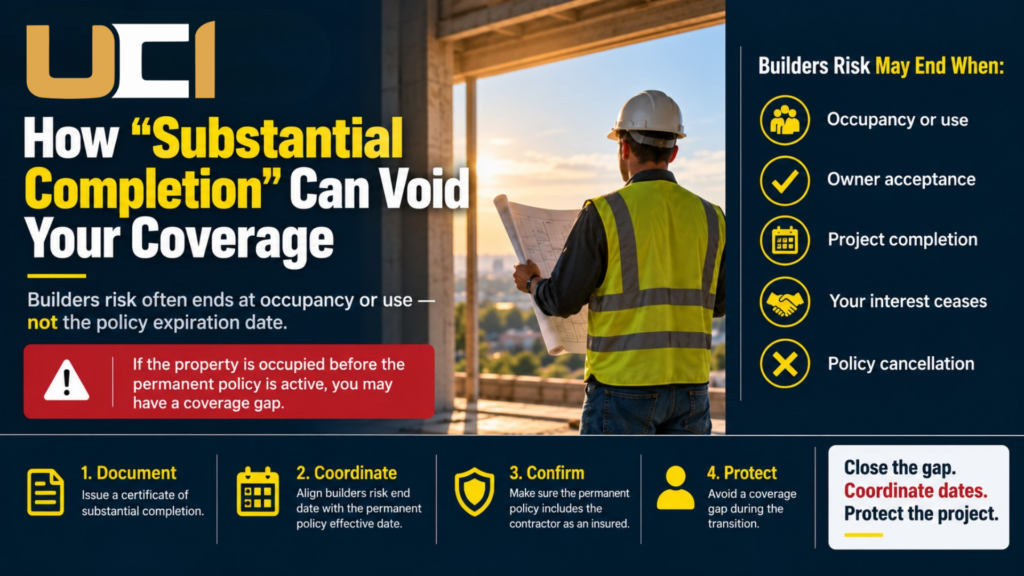
Occupancy and partial occupancy. Phased projects need partial occupancy endorsements before anyone occupies anything, because occupancy commonly terminates or restricts coverage under standard language.
Who buys it, and who is protected
On complex projects, builders risk is usually placed by the owner or the general contractor, with other parties named as insureds.
Two details matter to contractors.
Are you actually a named insured? Being mentioned in a certificate is not the same as being an insured under the policy.
Who bears the deductible? The policy does not answer this — the contract does. Construction agreements frequently assign deductibles to the party whose work caused the loss. On a project with a substantial water damage deductible, that can be a significant exposure for a mechanical or fire protection subcontractor.
Read the deductible provisions in your contract before you sign, not after a loss.
Frequently asked questions
What are LEG clauses in builders risk? LEG clauses are standardized defect exclusion wordings developed by the London Engineering Group. LEG 1 excludes all loss arising from a defect. LEG 2 covers resulting damage but excludes the cost of rectifying the defect itself. LEG 3 is broadest, excluding only the cost of improving the original design, material, or workmanship.
Which LEG clause should I want? LEG 3 provides the broadest protection and is worth pursuing on well-engineered projects with strong quality control. LEG 2 is the most common market position and is generally acceptable. LEG 1 is restrictive enough that it should usually be resisted on complex work.
What are soft costs in builders risk? Soft costs are the additional expenses a covered delay creates — extended loan interest, professional fees, general conditions, permit and insurance extensions, additional taxes, re-leasing costs, and on some forms liquidated damages. Coverage must be endorsed and is not automatic.
What is delay in start-up coverage? DSU covers the income an owner loses when a covered loss delays project completion. It is distinct from soft costs, which cover additional expenses rather than lost revenue. DSU matters most on income-producing assets such as hotels, multifamily, retail, and industrial facilities.
What is a waiting period deductible? It is a time-based deductible used with soft costs and DSU coverage, requiring a defined number of days of delay before benefits begin. Extending the waiting period lowers premium but can eliminate the coverage’s practical value if it exceeds a realistic delay.
Is testing and commissioning covered by builders risk? Often only partially. Many forms limit or exclude coverage during testing, and some distinguish cold testing from hot testing, treating hot testing more restrictively. On projects with significant systems, negotiate testing coverage explicitly and confirm duration, scope, and deductible.
Who pays the builders risk deductible on a complex project? The contract determines this, not the policy. Construction agreements commonly assign the deductible to the party whose work caused the loss. Given that water damage deductibles on large projects can be substantial, subcontractors should review these provisions before signing.
Does builders risk cover a defective design? Not the cost of the defective design itself in most cases. What varies is whether resulting damage is covered and how much of the rectification cost is excluded, which depends on the defect wording. That is precisely what the LEG clause distinction addresses.
Negotiate the wording, not just the number
On complex projects, the difference between a policy that responds and one that disappoints rarely comes down to limits.
It comes down to which defect wording applies, whether soft costs were endorsed and adequately sized, whether DSU exists where income is at stake, whether the waiting period is realistic, and how testing is treated.
Those terms are negotiable. They are also easy to accept as issued, because they arrive buried in a form while everyone focuses on premium and limits.
If you are placing or reviewing builders risk on a complex project, the useful exercise is to read the defect wording first, then confirm the soft costs and delay coverage match the project’s actual financial exposure. We can walk through a placement with you and identify where the wording falls short before it matters.
This article is general information, not legal advice. Builders risk forms, defect wordings, and endorsements vary significantly by carrier and placement. Review specific policy language with your broker and legal counsel.