

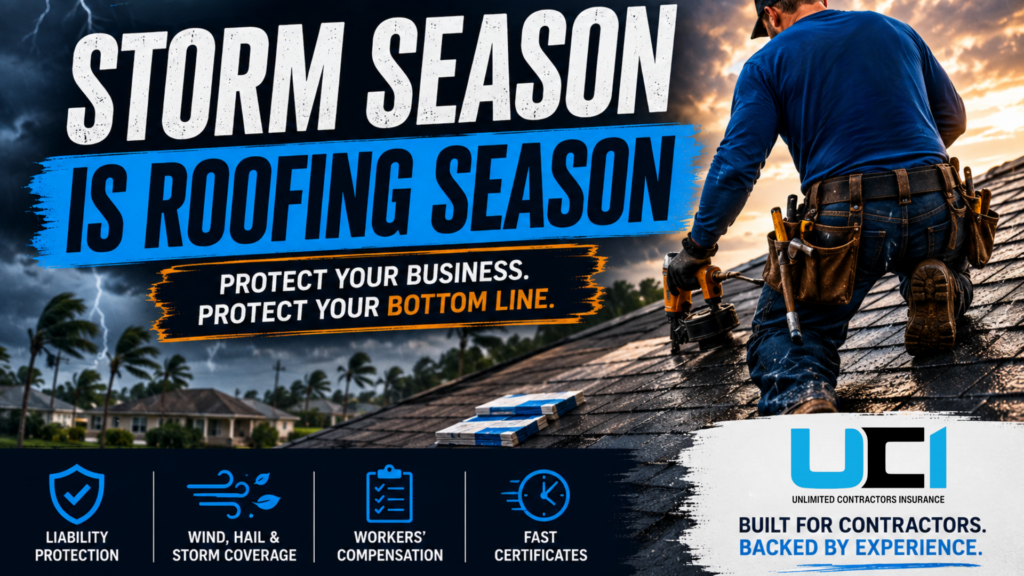
Every summer, the same thing happens. The sky opens up, shingles come off, phones start ringing, and roofers across the country go from “slow week” to “booked out through fall” overnight. Storm season is the busiest, most profitable stretch of the year for roofing contractors. It’s also the stretch where a single claim can wipe out a season’s profit if the wrong coverage — or no coverage — is in place.
At UCI, we place roofing risk for a living, including the hard-to-place accounts that standard carriers won’t touch. So here’s a straight-talk breakdown of the storms hitting this time of year, the regions carrying the most risk, and exactly what kind of insurance a roofer needs to work through it without getting exposed.
What’s Actually Hitting Right Now
Summer isn’t one storm season — it’s three overlapping ones, each with its own footprint and its own way of damaging roofs and racking up liability.
1. Atlantic Hurricane Season (June 1 – November 30)
The Atlantic season runs a full six months, but the real teeth come mid-September through October. For 2026, the major forecasters — NOAA, Colorado State University, and AccuWeather — are calling for a near-to-below-normal season, driven largely by a developing El Niño that tends to suppress tropical activity. NOAA is putting the odds of a below-normal season around 55 percent, with the various outlooks landing somewhere in the range of 6 to 16 named storms and a handful of hurricanes.
Here’s the trap in that forecast: “below normal” is a headcount, not a safety guarantee. In 2025, the basin produced a roughly average number of storms but still spun up three Category 5 hurricanes. It only takes one landfall on a populated coast to define the season. Forecasters are telling everyone from South Texas to Maine to prepare the same way regardless of the number.
Where the risk lives: the Gulf Coast (Texas, Louisiana, Mississippi, Alabama, Florida) and the Southeast and Eastern Seaboard up through the Carolinas and mid-Atlantic. Wind, wind-driven rain, and the flooding that follows are what tear roofs apart here.
2. Severe Thunderstorm, Hail, and Tornado Season (peaks March – September)
This is the bread and butter of the roofing trade — and the biggest single driver of storm-related insurance claims in the country. Hail alone routinely causes over a billion dollars in property damage when a storm parks over a metro.
For 2026, forecasters flagged the highest hail risk running from Texas through Alabama, with a second hotspot across Iowa, northern Missouri, eastern Nebraska, and northeastern Kansas. Through the season so far, the most active hail states have been Illinois, Iowa, Wisconsin, Ohio, and Missouri. The old idea of a single narrow “Tornado Alley” is outdated — the damaging-storm map now stretches deep into the Midwest and Southeast.
Specific high-frequency zones roofers should know:
- Colorado Front Range (“Hail Alley”). The I-25 corridor from Brighton through Thornton, Westminster, and Broomfield, plus Colorado Springs and the Palmer Divide, gets hammered year after year. Season runs April–September, peaking May through August, with June historically the worst month.
- Dallas–Fort Worth. Hail season runs May through September and 2026 opened with multiple hail-producing storms by mid-May, including golf-ball-sized stones across the northern metro.
- Oklahoma (OKC and Tulsa). March through June, peaking April–May.
- Nebraska (Omaha–Lincoln corridor). May through August, peaking June–July.
- Minnesota (Twin Cities and southern counties). May through September, peaking June–July.
Quarter-sized hail (1″) can damage asphalt shingles. Golf-ball-sized hail (1.75″+) typically means full roof replacements — and a flood of work for whoever’s licensed and insured to do it.
3. The Southwest Monsoon (June 15 – September 30)
Closer to UCI’s home turf, Arizona’s monsoon is its own beast. The seasonal wind shift pulls moisture north and detonates it into afternoon thunderstorms. The 2026 outlook leans near-average early with a wetter, more active late season (August into September) for Phoenix and Tucson.
The hazards aren’t hurricanes — they’re microbursts and downburst winds that can hit like a localized bomb, dust storms (haboobs), lightning, and flash flooding. Those outflow winds strip roofing and send debris flying, and the water intrusion behind a monsoon cell is what generates the repair calls. If you roof in Arizona, Nevada, or New Mexico, this is your storm season.
Why Roofers Carry More Risk During Storm Season — Not Less
More work is good. More exposure is the part that catches contractors off guard. During peak season:
- You scale up fast. More crews, more subs, faster hiring — and every new person is a new liability and a new workers’ comp exposure. Storm-chaser competition pressures everyone to move quicker than they should.
- You’re on steep, wet, hot roofs constantly. Falls are the number-one killer in construction, and roofing is the highest-hazard class code there is.
- Your own property is exposed to the same storms. Tools, equipment, and materials staged on-site or in transit sit right in the path of the weather that’s generating your work.
- You’re doing emergency tarping at height in marginal conditions — exactly when accidents and third-party property damage happen.
- Faulty-workmanship claims spike. A rushed repair that leaks in the next storm turns a happy customer into a lawsuit.
All of that is why roofing is one of the hardest trades to insure — and why so much of it lands in the excess & surplus (E&S) market instead of standard carriers. That’s the exact space UCI works in.
The Coverage Breakdown: What a Roofer Actually Needs
Here’s the stack, from foundation to the extras that matter most in storm country.
General Liability (GL) — the foundation. Covers third-party bodily injury and property damage: someone gets hurt, or you damage a customer’s home. Read it carefully — roofing GL policies often carry height/story limitations, hot-work or torch-down exclusions, and subcontractor warranties that void coverage if your subs aren’t properly insured. A cheap GL policy full of exclusions is worse than useless in a claim.
Workers’ Compensation — non-negotiable with employees. Required in most states the moment you have staff. Because of fall exposure, roofing sits in the highest-rated class codes, so classification and experience mod matter enormously. Solo operators often need a policy anyway to satisfy GCs. Watch how subs get classified — misclassification is a common, expensive mistake.
Commercial Auto. Trucks, trailers, and hauling materials to the jobsite. Make sure it includes hired and non-owned auto coverage for the trucks your crews drive that you don’t own.
Inland Marine / Tools & Equipment. Covers your tools and equipment off-site, in transit, and at the job — the property that standard property policies leave out the moment it rolls off your lot.
Installation Floater / Builder’s Risk. Covers materials being installed but not yet part of the structure. This is the coverage that saves you when a storm hits mid-job and destroys the shingles you’ve already staged and started but haven’t finished.
Professional Liability / Errors & Omissions. If you do roof inspections, moisture surveys, storm-damage assessments, or any design/consulting work, standard GL won’t respond to a mistake in your professional judgment. E&O fills that gap — increasingly relevant as roofers get pulled into insurance-claim work.
Umbrella / Excess Liability. Extra limits stacked on top of your GL and auto. Large commercial and GC contracts frequently require it, and given how severe storm-related claims can get, it’s the difference between a covered loss and a business-ending one.
Contractor’s Pollution / Environmental — and don’t skip the mold piece. Worth considering for tear-offs, sealants, torch-down fumes, or asbestos in older roofs. But for roofers, the bigger exposure is mold, and it’s the one that gets missed.
Here’s the pattern: you finish a roof in August. A flashing detail or a fastener penetration isn’t sealed the way it should be. Water gets into the deck and the wall cavity and sits there. Nobody sees anything for a year. Then the homeowner or building owner discovers mold behind the drywall, brings in a hygienist, and the remediation bill lands on your desk along with a claim for the interior damage — and sometimes a bodily injury claim for occupant health complaints on top of it.
The problem is that virtually every commercial GL policy carries a mold or “fungi and bacteria” exclusion. So does the pollution exclusion sitting next to it. Your GL will typically respond to the water damage from a bad install, but the moment the word mold enters the claim, coverage can stop cold — and mold is almost always the expensive part, because remediation means tearing out and rebuilding whatever the water touched.
This is why it needs to be bought back deliberately: either a contractor’s pollution liability (CPL) policy that includes fungi/mold coverage, or a specific mold buy-back endorsement on your GL. Two things to check on whatever you’re offered — whether it covers completed operations (a leak that surfaces long after you left the job, not just something that happens while your crew is on-site) and what the sublimit is, since mold coverage is frequently capped well below your GL limit.
Storm season makes this worse in two directions. Rushed work in peak season is exactly what produces the marginal flashing detail that leaks later, and the water intrusion driving your emergency calls is the same water that starts growing mold in someone else’s building within 24 to 48 hours.
Location Changes the Policy — Not Just the Price
Where you work reshapes the coverage itself:
- Coastal / hurricane wind zones (Gulf, Southeast, Eastern Seaboard): expect named-storm and hurricane deductibles calculated as a percentage of insured value rather than a flat dollar amount, plus flood exclusions (flood is always separate — NFIP or private). Carrier capacity has tightened hard in Florida, Texas, and along the Gulf, which makes placement tougher and underwriting stricter in Tier 1 wind counties.
- Hail alley (Texas–Alabama, Front Range, Plains, Midwest): separate, higher wind/hail deductibles are the norm, and loss history in these territories drives rates and eligibility.
- Monsoon country (Arizona and the Southwest): the concern shifts to microburst/wind damage and monsoon water intrusion rather than hurricane deductibles — but the underwriting still scrutinizes your claims history closely.
The Bottom Line
Storm season pays the bills for roofers — but it’s also when the wrong policy shows its holes. Between hurricane exposure on the coasts, hail across the Plains and Midwest, and monsoon winds in the Southwest, the trade is running full-tilt into the exact weather that generates the biggest claims of the year.
If your GL is stuffed with exclusions, your subs aren’t verified, or you’ve been quietly declined by a standard carrier because “roofing is too hard to place,” that’s not a dead end — it’s precisely what UCI does. We specialize in contractor and roofing risk, including the tough E&S accounts other agencies pass on.
Get your coverage reviewed before the next storm rolls through — not after.
Request Your Free Coverage Review
This article is for general informational purposes and does not constitute insurance or legal advice. Coverage terms, exclusions, and availability vary by carrier, policy, and location. Talk to a licensed UCI agent for guidance specific to your operation.