

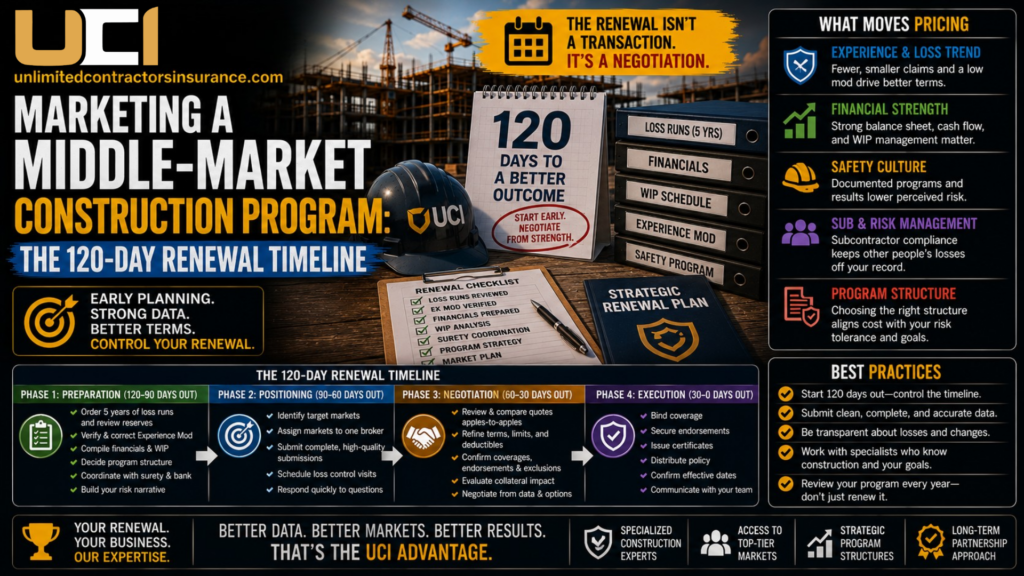
A small contractor’s renewal is a transaction. A middle-market construction program is a negotiation.
That distinction changes everything about how you approach it. Underwriters at this level are not rating an application. They are evaluating a business, forming a view on its management, and deciding how much of their capacity to commit. Those decisions take time, and they happen well before a quote arrives.
Contractors who start ninety days out are already behind. Contractors who start at 120 days control the process.
This guide lays out that timeline month by month, explains what actually moves pricing at this level, and covers the strategic decisions — market selection, incumbent handling, program structure — that determine your outcome long before anyone issues a number.
Why 120 days, not 90
Ninety days is the standard advice, and it works for straightforward accounts. Middle-market construction programs are not straightforward.
Several things extend the timeline. Underwriters need financial statements, work-in-progress schedules, and five years of loss data. Program structure decisions — guaranteed cost versus loss-sensitive — require modeling before you can even request quotes. Surety coordination adds another party. Loss control visits must be scheduled. And if collateral is involved, your bank enters the process too.
There is also a practical constraint. Most construction accounts renew in the same handful of months, so underwriters face their heaviest submission volume exactly when you need attention. Early submissions get considered. Late ones get declined for lack of time.
The four phases
| Phase | Timing | Focus |
| Preparation | 120–90 days out | Data assembly, structure decisions, strategy |
| Positioning | 90–60 days out | Submission, market selection, underwriter engagement |
| Negotiation | 60–30 days out | Quotes, structure refinement, terms |
| Execution | 30–0 days out | Binding, endorsements, distribution |
Each phase depends on the one before it. Skip preparation, and you spend the negotiation phase answering questions you should have anticipated.
Phase 1: Preparation (120–90 days out)
This phase determines your outcome more than any other. Everything you do later works with the material you assemble now.
Pull your data early
Start with loss runs. Request five years, valued as recently as possible, for every line. Carriers are frequently slow to produce them, which is why this happens first rather than later.
Then review what they show. Look for open claims with reserves that no longer reflect likely outcomes. Push your carrier and adjusters to close resolved files and correct inflated reserves before the data goes to market.
This step matters enormously. Underwriters read your loss runs before they read anything else, and stale reserves make your experience look worse than it actually is.
Verify your experience modification
Pull your modification worksheet and check it carefully. Errors appear more often than most contractors expect.
Look for claims attributed to the wrong entity, subrogation recoveries that were never credited, duplicate entries, and payroll figures that do not match your records. Corrections run through the rating bureau, and they take time.
Assemble the financial package
Middle-market underwriting is financial underwriting. Prepare:
- Audited or reviewed financial statements, current and prior years
- Work-in-progress schedules showing backlog, billings, and estimated costs to complete
- Your bonding capacity and current surety relationship
- Ownership structure and any recent changes
Your WIP schedule deserves particular attention. Underwriters read it for backlog quality, project concentration, and whether your growth outpaces your capability.
Decide your program structure
Before marketing, resolve whether you are pursuing guaranteed cost, a loss-sensitive structure, or a captive.
That decision drives everything downstream — which markets you approach, what collateral you need, and how you frame the submission. Model the alternatives now, including collateral requirements and their effect on your bonding capacity.
Involve your surety in this conversation. Sureties would far rather weigh in early than discover a large letter of credit during an underwriting review.
Build the narrative
Underwriters price uncertainty. Your job is to remove it.
Write a genuine account of your business: what you build, where, for whom, and how you manage risk. Explain every significant loss — what happened, what it cost, and specifically what changed afterward.
That last part carries real weight. Underwriters have seen worse loss runs than yours. What they are evaluating is whether you understand your losses and did something about them.
Phase 2: Positioning (90–60 days out)
Now you take the account to market. Strategy matters more than volume here.
Choose markets deliberately
Middle-market construction is written by a defined set of carriers, and their appetites differ meaningfully. Some want general contractors. Others prefer specialty trades. Some avoid residential entirely. Certain markets write loss-sensitive structures well; others do not.
Approaching the wrong markets wastes weeks and produces declinations that other underwriters may eventually hear about.
Work with your broker to identify a focused list — typically a handful of genuine candidates rather than a broad canvass.
Assign markets to one broker only
This point is non-negotiable, and contractors violate it constantly.
When two brokers submit the same account to the same carrier, underwriters typically block it entirely. You lose access to a market that might have quoted, and you signal disorganization.
If you want competitive tension, use broker of record assignments — give each broker exclusive access to a specific set of markets, in writing, so nobody collides. Your incumbent broke
r generally keeps the incumbent carrier.
Decide how to handle the incumbent
Your current carrier occupies a particular position. They know your account, and switching carries friction.
Two approaches work. You can invite them to compete alongside others, which tests whether their renewal is genuinely competitive. Or you can negotiate with them first, and go to market only if the terms fall short.
Either is defensible. What fails is leaving them uncertain about their standing while you shop broadly, because incumbents who sense they are being used as leverage often respond by pricing defensively.
Get underwriters in front of the business
At this level, a submission on paper competes against a submission with a relationship behind it.
Arrange underwriter meetings or jobsite visits for your priority markets. Bring your safety director. Show the actual operation.
Underwriters who have walked your jobsite and met your management team price the account differently than underwriters working from a PDF. This is the single most underused advantage available to middle-market contractors.
Schedule loss control early
If carriers want loss control surveys, get them scheduled now. Waiting until quotes are due compresses everything and gives the surveyor a rushed impression.
Phase 3: Negotiation (60–30 days out)
Quotes arrive. This is where structure matters more than headline pricing.
Compare total cost, not premium
Premium alone tells you very little at this level, particularly when comparing structures.
Build a total cost comparison including premium, expected retained losses, collateral costs, TPA and program fees, and the surety impact of any collateral. A loss-sensitive quote with a lower premium may cost more in total, or considerably less, depending on assumptions.
Model each option under expected, adverse, and stress loss scenarios.
Negotiate the terms that outlast the price
Price gets attention. Terms determine what you actually own.
Focus on:
- Coverage form and exclusions — particularly residential, height, action-over, and subcontractor warranty provisions
- Additional insured endorsements, including completed operations, and whether the umbrella follows form
- Collateral formula and release schedule, if a loss-sensitive structure is involved
- Aggregate stop-loss, which caps your bad-year exposure
- TPA selection rights, since you should control who adjusts claims you fund
- Audit provisions and how disputes get resolved
- Multi-year rate protection, where available
An exclusion discovered at claim time costs more than any premium difference you negotiated.
Verify carrier acceptability
Check your contracts. Many owner agreements require admitted carriers or specify minimum financial strength ratings.
A quote you cannot use on your own projects is not a quote. Confirm acceptability before you get attached to a number.
Coordinate with your surety
If your structure involves collateral, your surety needs to see the final numbers. Give them time to respond rather than presenting a completed decision.
Phase 4: Execution (30–0 days out)
The work is mostly done. Now execute cleanly.
Bind with adequate margin
Do not bind in the final week. Late binding produces errors, and errors in insurance documentation surface at the worst possible moments.
Confirm the endorsements actually exist
This is where contractors get caught. A quote promising additional insured status, primary and non-contributory wording, and waivers of subrogation means nothing until the endorsements are issued.
Request the actual endorsement forms. Verify each requirement your contracts impose.
Distribute certificates promptly
Owners and general contractors need updated certificates. Compliance systems flag lapses automatically, and a flagged sub can see payments held.
Send certificates before the renewal date, not after.
Update your subcontractor requirements
If your own coverage changed, review what you require from subcontractors. Your downstream requirements should always satisfy your upstream obligations.
Prepare for the audit
Your rating basis will be audited. Organize payroll by classification, separate the overtime premium portion, and confirm your subcontractor certificate file is complete for the full period each sub worked.
What actually moves pricing at this level
Beyond loss history, underwriters respond to specific signals. These are the ones worth investing in.
Documented safety programs. Training rosters, toolbox talks, competent person designations, and evidence of enforcement — not a binder nobody opens.
Claims discipline. Immediate reporting, active management, a return-to-work program, and quarterly loss reviews.
Subcontractor controls. Written contracts, collected endorsements, tracked expirations, and enforcement tied to payment.
Financial stability. Clean statements, adequate working capital, and a backlog that matches your capability.
Management quality. This is subjective, and it matters. Underwriters form views about whether a contractor is well run, and those views show up in pricing.
Responsiveness. Contractors who answer questions quickly and completely get better outcomes than those who do not.
The calendar
| Days out | Actions |
| 120 | Request loss runs for all lines. Pull the mod worksheet and check for errors. Begin financial package assembly. |
| 110 | Review open claims and push for reserve corrections and closures. Model program structure alternatives. |
| 100 | Decide structure. Consult your surety on collateral implications. Draft the business narrative and loss explanations. |
| 90 | Finalize submission package. Select target markets with your broker. Issue broker of record assignments if using more than one. |
| 80 | Submit to market. Decide incumbent strategy. Schedule underwriter meetings and jobsite visits. |
| 70 | Complete underwriter meetings. Schedule loss control surveys. Respond to information requests immediately. |
| 60 | First quotes arrive. Begin total cost modeling across structures and scenarios. |
| 50 | Negotiate terms — coverage form, collateral, stop-loss, TPA rights, endorsements. |
| 40 | Verify carrier acceptability against contract requirements. Coordinate final numbers with your surety. |
| 30 | Select the program. Confirm all negotiated terms appear in the binder. |
| 20 | Bind coverage. Request actual endorsement forms. |
| 10 | Verify endorsements. Prepare certificates for distribution. |
| 0 | Distribute certificates. Update subcontractor requirements. Set the audit preparation calendar. |
Frequently asked questions
When should a middle-market contractor start the renewal process?
About 120 days before renewal. Middle-market construction programs require financial underwriting, structure decisions, surety coordination, loss control scheduling, and sometimes bank involvement for collateral. Ninety days works for simple accounts but compresses everything at this level.
What documents do underwriters need for a construction program?
Five years of loss runs for every line, your experience modification worksheet, audited or reviewed financial statements, work-in-progress schedules, your safety program with training documentation, claims handling procedures, subcontractor insurance requirements, and written explanations of significant losses.
Should I use multiple brokers to market my program?
Only with written broker of record assignments dividing markets between them. When two brokers approach the same carrier, underwriters typically block the submission and you lose that market entirely. Assign each broker an exclusive set of carriers.
How should I handle my incumbent carrier?
Either invite them to compete openly alongside other markets, or negotiate with them first and go to market only if terms fall short. Both approaches work. What fails is leaving the incumbent uncertain about their standing, since they often respond by pricing defensively.
What should I negotiate besides premium?
Coverage form and exclusions, additional insured endorsements including completed operations, collateral formula and release schedule, aggregate stop-loss, TPA selection rights, audit provisions, and multi-year rate protection where available. Terms determine what you actually own.
Why do reserves matter before marketing?
Underwriters read loss runs first, and open claims are valued at whatever the carrier has reserved rather than what they will ultimately cost. Inflated reserves make your experience look worse than it is, so pushing for corrections before data goes to market directly affects pricing.
What if my current carrier non-renews?
Move immediately and use the full notice period as a marketing timeline. Assemble loss runs and a written explanation of what drove the losses and what changed. Non-renewal is often a portfolio or appetite decision rather than a judgment on your account, and a strong submission still competes well.
Control the process instead of receiving it
Renewal outcomes at this level are largely determined before quotes exist. Your loss runs, your reserve accuracy, your financial presentation, your market selection, and whether underwriters have actually met your team all shape the result more than any negotiation in the final month.
By day 30, most of that is fixed. You are choosing among the options your preparation produced.
The contractors who consistently secure better programs are not better negotiators. They start earlier, present more completely, and treat their renewal as a process they run rather than one that happens to them.
If you would like help building the submission package, modeling structure alternatives against your loss history, or mapping the timeline against your renewal date, that conversation is far more valuable at 120 days than at 45.
This article is general information, not legal, tax, or actuarial advice. Market conditions, carrier appetites, and program structures vary. Review your specific renewal strategy with your broker, surety, and advisors.