

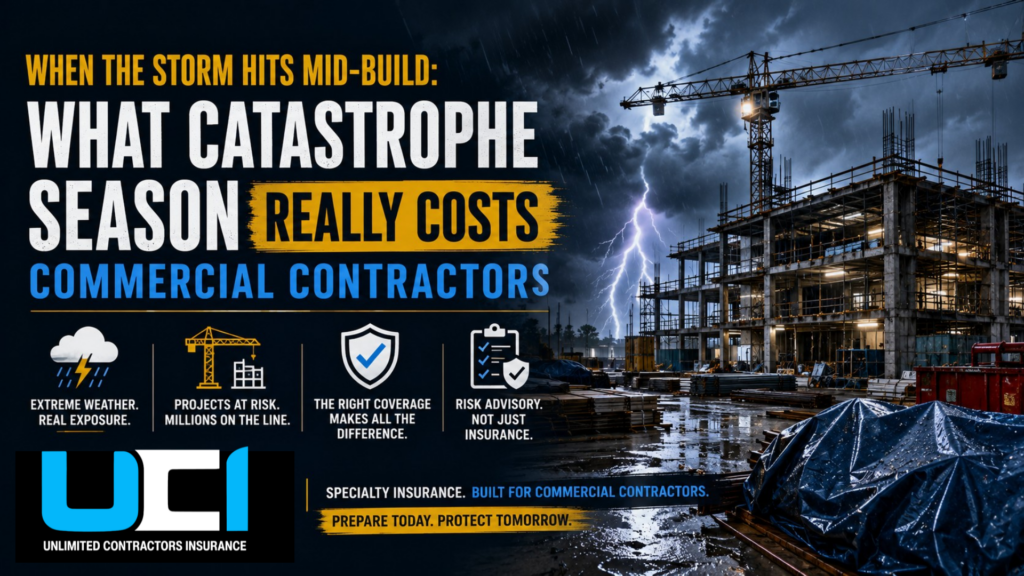
A hailstorm over a finished subdivision is a re-roof. A hurricane’s outer bands over an active commercial jobsite — with the structure dried-in but not sealed, half a million dollars of installed materials exposed, a lender watching the draw schedule, and liquidated damages ticking on the completion date — is a very different kind of problem. Same weather. Two completely different balance sheets.
Summer through fall is peak catastrophe season across most of the country, and for commercial construction firms it lands at the worst possible time: mid-project, mid-schedule, mid-financing. UCI is a specialty brokerage for established commercial contractors — from $5M specialty trades to $100M+ design-build, EPC, and heavy-civil firms — and we treat these programs as risk advisory, not order-taking, precisely so a bad-weather week doesn’t turn into a seven-figure loss with a stalled project attached. Here’s the honest breakdown of what’s coming this season, where the exposure concentrates, and the coverage that actually responds when a storm hits a job in progress.
The 2026 Storm Picture
This time of year isn’t one hazard — it’s three overlapping seasons, each capable of shutting down a jobsite.
Atlantic Hurricane Season (June 1 – November 30)
The season runs six months, but the peak is mid-September through October. For 2026, NOAA and AccuWeather are all leaning toward a near-to-below-normal season, driven largely by a developing El Niño that tends to suppress tropical activity. NOAA has put the odds of a below-normal season near 55 percent.
For a contractor, the forecast’s headline number is the least useful part of it. “Below normal” is a storm count, not a guarantee — in 2025 the basin produced a roughly average number of storms yet still spun up three Category 5 hurricanes. It takes exactly one landfall near an open jobsite to define your season. If you’re building anywhere from South Texas to Maine, the planning assumption doesn’t change with the forecast.
Where it concentrates: the Gulf Coast (Texas, Louisiana, Mississippi, Alabama, Florida) and the Southeast and mid-Atlantic seaboard. Wind, wind-driven rain, and storm surge are what stall coastal projects — and what carriers price hardest.
Severe Thunderstorm and Hail Season (peaks March – September)
Hail is the quiet giant of construction losses — routinely more than a billion dollars in damage when a storm parks over a metro. For 2026, forecasters flagged the highest hail risk from Texas through Alabama, plus a Midwestern hotspot across Iowa, northern Missouri, eastern Nebraska, and northeastern Kansas. Illinois, Iowa, Wisconsin, Ohio, and Missouri have been among the most active states so far this year. The old “Tornado Alley” framing is outdated; the damaging-storm footprint now runs deep into the Midwest and Southeast.
For UCI’s contractor base, two zones matter most: the Texas metros (DFW’s hail season runs May through September) and Colorado’s Front Range “Hail Alley” along the I-25 corridor, where April-through-August storms hammer active construction year after year. On a jobsite, hail doesn’t just dent finishes — it shreds exposed membrane, damages stored materials and equipment, and cracks the schedule open.
The Southwest Monsoon (June 15 – September 30)
Across Arizona and the desert Southwest, the monsoon brings microbursts and downburst winds that hit like a localized bomb, dust storms (haboobs), lightning, and flash flooding. The 2026 outlook leans toward a wetter, more active late season (August into September) for Phoenix and Tucson. These aren’t hurricane-scale systems, but the outflow winds flatten temporary structures, scatter staged materials, and the flash flooding behind a monsoon cell floods excavations and undermines site work.
Why Commercial Construction Carries Outsized Catastrophe Exposure
A homeowner’s storm loss is a repair. A commercial contractor’s storm loss compounds across every part of the deal at once:
- Millions in value sits exposed on an open site. Installed materials that aren’t yet part of a completed, insured structure are in the most vulnerable state they’ll ever be — and standard property policies don’t touch them.
- The schedule has teeth. Liquidated damages, milestone draws, and completion deadlines mean a storm delay isn’t just cleanup cost — it’s penalty cost and extended financing.
- Lenders and owners demand it. Project financing and owner contracts dictate coverage terms, deductibles, and named insureds. Get the structure wrong and you’re out of compliance the moment a claim hits.
- The liability tail is long. Completed-operations claims can surface years after a job closes — a roof or envelope that fails in a later storm still traces back to the contractor who built it.
- Wrap-ups multiply the parties. On an OCIP or CCIP, a single event touches every enrolled contractor and sub at once, and the coverage has to be structured so it actually responds across all of them.
That complexity is exactly why catastrophe planning for a commercial firm is a brokerage problem, not a quote-engine problem — and it’s the work UCI is built to do.
The Coverage Breakdown — Tailored to How You Actually Build
Here’s the stack that determines whether a storm on an active project is a covered event or a crisis.
Builder’s Risk (All-Risk) — the centerpiece of storm season. This is the policy that covers the structure while it’s under construction, and it’s where most catastrophe losses live. The details decide everything: water-damage sublimits, named-storm and wind/hail deductibles (often a percentage of project value in cat-exposed zones, not a flat dollar figure), coverage for materials in transit and in temporary storage, and who’s named — owner or GC — especially inside a wrap. A cheap builder’s risk policy with a low water sublimit and a fat wind deductible is a gap waiting for the first storm.
Delay in Completion / Soft Costs. The coverage most contractors overlook until they need it. When a covered event pushes the schedule, this responds to the consequential costs — extended loan interest, additional financing, re-inspection and permitting, and in some forms the liquidated damages and lost income that a delay triggers. On a financed commercial project, this is frequently the largest part of the real loss.
Wrap-Up Programs (OCIP / CCIP). On owner- or contractor-controlled programs — common on GMP and design-build work — general liability and completed operations for every enrolled party run through one structure. A catastrophe tests whether that structure was built correctly: enrollment, carve-outs, and completed-ops tails all have to line up, or a single event exposes gaps across the whole project.
Commercial General Liability. Per-project aggregates, completed-operations coverage, and additional-insured language that holds up when a contract is actually tested — including the storm-driven third-party and completed-work claims that can surface long after closeout.
Excess & Umbrella Towers. Catastrophe-driven claims are severity events, and severity is what excess is for. Towers structured from $10M into $100M+ across admitted and E&S markets — quota-share and layered — are routinely required by owners and lenders on larger work, and they’re the difference between a covered loss and a firm-ending one.
Subcontractor Default Insurance / Surety Bonding. Storm season is also crunch season, and a key sub folding mid-schedule can stall a project as surely as the weather. SDI (SubGuard) and performance/payment bonds keep the job moving when a subcontractor can’t — and choosing correctly between them is a structuring decision, not a checkbox.
Contractor’s Pollution / Environmental. Essential for the restoration and remediation vertical, where post-storm water, fire, and mold work runs straight into the pollution and mold claims that standard policies routinely exclude.
Location Reshapes the Program — Not Just the Rate
Where you build changes the coverage itself:
- Coastal wind zones (Florida, Texas, the Gulf, the Southeast seaboard): expect named-storm and hurricane deductibles calculated as a percentage of insured value, flood treated as a separate placement, and real capacity constraints — builder’s risk and property markets have tightened hard in cat-exposed states, which makes structuring and timing matter.
- Hail country (Texas and the Colorado Front Range): separate, higher wind/hail deductibles are standard, and project-site loss history drives both rate and eligibility.
- Monsoon country (Arizona and the Southwest): the exposure shifts to microburst wind and flash-flood water intrusion on active sites rather than hurricane deductibles — but underwriting scrutiny is no lighter for it.
Because appetite, capacity, and contract language differ by state and by trade, the right program is assembled deliberately — matched to the vertical and the jurisdiction — rather than pulled off a shelf.
Catastrophe Planning Starts at Discovery — Not Renewal Week
Storm losses turn into disasters mostly because of timing: most contractors only look hard at their builder’s risk, deductibles, and tower when renewal lands — often after the season is already underway. UCI runs a year-round stewardship cycle that puts the catastrophe questions up front, where they belong.
It starts with Risk Discovery — an on-site look at the active project portfolio, a five-year read on loss runs and EMR history, a pass through your live contract templates, and a named-perils exposure analysis, delivered as a written assessment. From there, Program Design models limits, retention, wrap eligibility, and tower structure before a single carrier is approached. Market Placement then goes to executive-level underwriters across 30+ commercial-construction appetites, admitted and E&S. And Active Stewardship keeps it honest year-round — subcontractor compliance tracking, mid-term contract reviews, EMR monitoring, and claims advocacy when an event actually hits.
For catastrophe season specifically, that means your wind and hail deductibles, water sublimits, soft-cost coverage, and tower limits get pressure-tested in the spring — not discovered in an adjuster’s report in September.
The Bottom Line
Catastrophe season doesn’t wait for your project to close out. Between hurricane exposure on the coasts, hail across Texas and the Front Range, and monsoon winds in the Southwest, the storms that generate the biggest construction losses of the year land squarely in the middle of your build calendar — and for a commercial firm, the loss is never just the damage. It’s the delay, the financing, the penalties, and the liability tail behind it.
That’s the work UCI does. As the commercial-construction division of Affordable Contractors Insurance, we place full programs for established contractors — builder’s risk with sublimits and soft-cost coverage that actually respond, wrap-ups structured to hold, umbrella towers sized to the risk, and surety and default programs that keep projects moving — across 30+ carrier appetites, including Travelers, Zurich, CNA, The Hartford, and Chubb. Every account is led by a named, CRIS-credentialed senior advisor with a direct line, not a rotating queue.
No online quote engine. No scripted inside sales. When you request a Risk Review, a senior advisor reaches you within one business day to schedule a discovery call — bring your current declaration pages, five-year loss runs, and the contract on your largest active project, and UCI brings back a written exposure analysis.
Get your builder’s risk, your wrap, and your tower pressure-tested before the next storm rolls through a jobsite — not after.
This article is for general informational purposes and does not constitute insurance or legal advice. Coverage terms, exclusions, sublimits, deductibles, and availability vary by carrier, policy, project, and jurisdiction. Speak with a licensed UCI advisor for guidance specific to your operations.