
For growing contractors, subcontractors, and construction firms, certificates of insurance are supposed to create clarity. In theory, a COI should make it easy to verify coverage, confirm compliance, and move work forward. But once a business starts managing multiple jobs, multiple trades, and multiple subcontractors at once, that process often begins to break down.
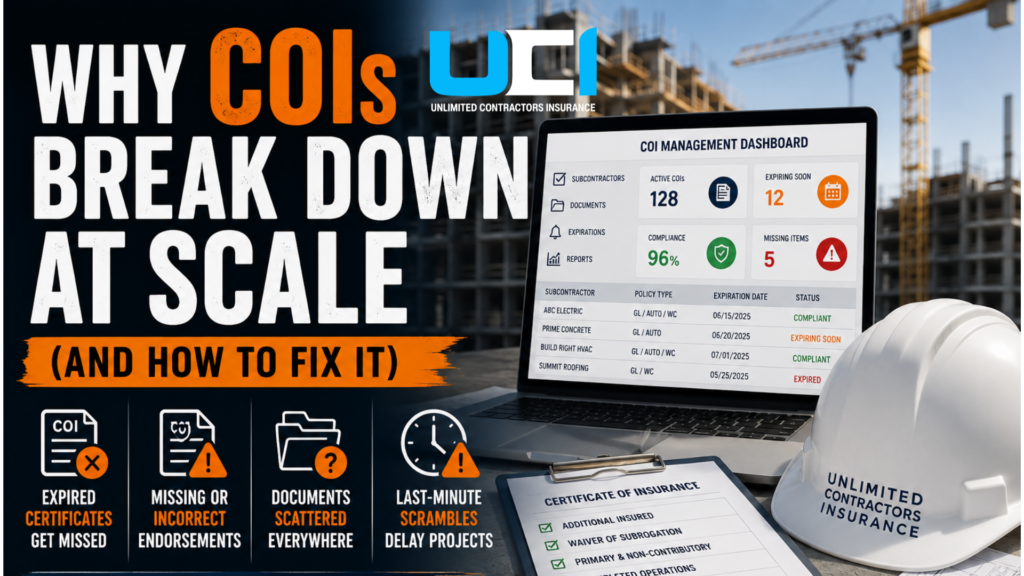
What works on a small project can become a serious operational liability at scale. A few subcontractors may be manageable with spreadsheets, inbox searches, and manual follow-up. But when a contractor is dealing with dozens or hundreds of active certificates across jobsites, renewals, endorsements, and contract requirements, the process becomes harder to control. Expired certificates get missed. Incorrect endorsements slip through. Teams work from outdated documents. Jobs get delayed because the right insurance proof is not ready when it needs to be.
This is where COI management stops being an administrative task and becomes a business risk. For larger contractors especially, broken COI workflows can slow project momentum, create compliance exposure, and damage relationships with owners, developers, and general contractors.
What a COI Is Really Supposed to Do
A certificate of insurance is not just a piece of paperwork. It is a snapshot of the subcontractor’s insurance program at a specific point in time. It helps confirm whether the subcontractor appears to carry the required policies, limits, and carriers needed to step onto a jobsite or continue working on one.
In construction, COIs are often used to support vendor onboarding, subcontractor approval, contract compliance, and ongoing risk review. They are meant to give contractors and project stakeholders enough visibility to spot missing coverage before it creates a real problem.
But that only works when the COI process is organized, timely, and tied to the actual requirements of the project. A certificate sitting in an email thread does not create compliance by itself. A file saved in a folder does not guarantee the right endorsements are in place. And a COI collected once at the beginning of a project does not protect a contractor six months later when the policy has expired.
Why COIs Start Failing as Operations Grow
The biggest reason COI systems fail at scale is simple: the business grows faster than the process behind it.
A contractor may begin with a handful of subs and a relatively simple workflow. Someone on the team collects certificates, saves them in a folder, and follows up when something looks off. That may work for a while. But once the company is running more jobs simultaneously, adding more trades, and taking on larger contractual requirements, that same approach becomes fragile.
Manual systems depend too heavily on individual memory and scattered communication. One team member may have the latest certificate, while another is relying on an old version. One project manager may know that a subcontractor still needs additional insured status, while accounting assumes everything is approved. As more people and projects get involved, the cracks start to widen.
The result is not always dramatic at first. Sometimes it shows up as a delayed start date, a last-minute scramble before mobilization, or confusion over whether a subcontractor is cleared to continue work. Over time, though, these small breakdowns compound into a much larger operational problem.
The Most Common COI Breakdowns
Expired certificates stay in circulation
One of the most common failures is relying on certificates that are no longer current. A subcontractor may have submitted a valid COI at the start of the project, but if the policy expires mid-job and nobody tracks it properly, that subcontractor may still be working without up-to-date proof of coverage.
For contractors with multiple active projects, this is a major exposure point. Insurance compliance is not static. It has to be monitored continuously.
The COI exists, but the endorsements do not
A certificate can look fine on the surface and still fail the actual job requirements. This happens when teams assume that the COI alone confirms compliance, without reviewing whether the right endorsements back it up.
For example, a contract may require additional insured status, waiver of subrogation, or primary and non-contributory wording. If those items are not actually included where required, the COI may create a false sense of security rather than real protection.
Documents live in too many places
As companies grow, COI records often end up spread across email inboxes, shared drives, text messages, PDFs, accounting systems, and project management tools. When that happens, teams lose confidence in which version is current.
This creates friction across the business. Operations may think a subcontractor is approved. Project management may still be waiting on updated paperwork. Compliance may not even know there is an issue until the last minute.
Follow-up becomes reactive instead of proactive
At scale, many companies end up chasing certificates only when a deadline is already here. Instead of receiving renewal reminders early and resolving missing documents in advance, the team is stuck reacting when a project is about to start, an audit is approaching, or a client asks for proof immediately.
That reactive cycle is where delays, stress, and mistakes multiply.
Why This Matters More on Larger Construction Projects
The larger the contract, the less room there is for insurance sloppiness.
High-value projects typically involve tighter contract language, more stakeholders, and greater scrutiny around subcontractor documentation. Owners, developers, general contractors, lenders, and legal teams may all have expectations around insurance verification. On those projects, COI management is not just administrative housekeeping. It is part of how the contractor demonstrates professionalism, readiness, and control.
When certificates break down at scale, the consequences can include jobsite delays, rejected subs, payment slowdowns, breach of contract disputes, and avoidable claim complications. In some cases, a contractor may not realize there is a gap until after an incident occurs, when the missing endorsement or expired policy becomes far more expensive than the time it would have taken to fix it earlier.
That is why larger contractors cannot afford to treat COI tracking as a side task. It needs structure, ownership, and repeatable systems.
The Operational Signs Your COI Process Is Not Scaling
A broken COI system rarely announces itself clearly. More often, it shows up through recurring friction across the business.
You may already have a scaling problem if your team regularly experiences issues like these:
- Subcontractors are being approved based on old certificates
- Project managers and admins are working from different records
- Renewal dates are tracked manually in spreadsheets
- The team cannot quickly confirm who is compliant and who is not
- Missing endorsements are discovered right before mobilization
- Staff spend too much time chasing paperwork by email
- Jobsites depend on one or two people who “just know where everything is”
These are not just workflow annoyances. They are signals that your COI process is overly dependent on manual coordination and vulnerable to failure as the business grows.
How to Fix COI Breakdowns Before They Hurt the Business
Centralize certificate management
The first step is to stop letting COIs live everywhere. Contractors need one reliable system for storing, reviewing, and updating certificate records. If your team cannot immediately answer whether a subcontractor is compliant, where the latest document is, and when it expires, the process is too fragmented.
Centralization creates visibility. It also reduces the risk of one department working off outdated information while another thinks the issue has already been resolved.
Track expiration dates automatically
Manual renewal tracking is one of the fastest ways to lose control. As subcontractor counts increase, there must be a dependable way to flag upcoming expirations before they become emergencies.
A scalable COI process should allow your team to identify expiring policies early, prioritize follow-up, and keep work moving without last-minute surprises.
Tie COIs to actual contract requirements
Not every job requires the same insurance structure. That is why contractors need to review certificates against the specific requirements of the project, not just against a generic checklist.
A better system connects the certificate review process to the real contractual obligations involved, including policy limits, named parties, and required endorsements. That is how contractors move from collecting paperwork to managing compliance with intent.
Create accountability internally
Strong COI management also requires clear ownership. When no one is fully responsible, documents get assumed, overlooked, or passed around without resolution.
Contractors need a defined internal process for who collects certificates, who reviews them, who follows up on missing items, and who gives final approval. That clarity matters even more as teams expand across multiple projects and markets.
COI Management Is Really a Risk Management Function
Many contractors still treat certificate tracking like back-office administration. In reality, it is closer to operational risk control.
The reason is simple: a broken COI system affects more than filing. It affects whether subcontractors can work, whether contractual obligations are being met, whether claims defenses are stronger or weaker, and whether the business can prove it had the right protections in place when it mattered.
For contractors managing larger books of business, that means COI handling should be viewed through the same lens as contract review, safety oversight, and financial controls. It is one of the quiet systems that either supports scale or starts undermining it.
What Better COI Infrastructure Looks Like
A stronger COI process is not just about collecting documents faster. It is about building a system that gives contractors visibility, consistency, and confidence.
That usually means:
- One place to store and review active certificate records
- Automated reminders for upcoming expirations
- Clear status tracking for compliant and non-compliant subcontractors
- A process for identifying missing endorsements early
- Shared visibility across compliance, project management, and operations
- Less reliance on email chains and memory-based follow-up
When that infrastructure exists, contractors can move faster without losing control. They can onboard subcontractors more efficiently, respond to document requests more confidently, and reduce the risk of insurance issues slowing down project execution.
Why This Matters for Growth-Focused Contractors
As construction companies grow, insurance administration becomes more complex whether they plan for it or not. The question is whether the systems behind the business are ready to support that growth.
COIs often look like a small detail until they start affecting schedules, approvals, and project momentum. Then suddenly the weakness in the system becomes visible. The contractors that handle growth best are usually the ones that solve these operational bottlenecks early, before they become expensive patterns.
At a certain level, clean COI handling is not just about staying organized. It becomes part of how a contractor protects margin, maintains credibility, and stays ready for larger, more demanding work.
Final Thought
COIs do not usually fail because contractors do not care. They fail because manual processes that worked at one stage of the business stop working at the next.
If your company is managing more subcontractors, more projects, and more contractual complexity than it was a year ago, now is the time to look closely at how certificate compliance is being handled. A process that feels “good enough” today may already be creating risk behind the scenes.
The fix is not just collecting more paperwork. It is building a smarter, more scalable way to verify, track, and manage insurance compliance across the life of the project.
Need a smarter insurance structure that can support larger projects and more complex compliance demands?