

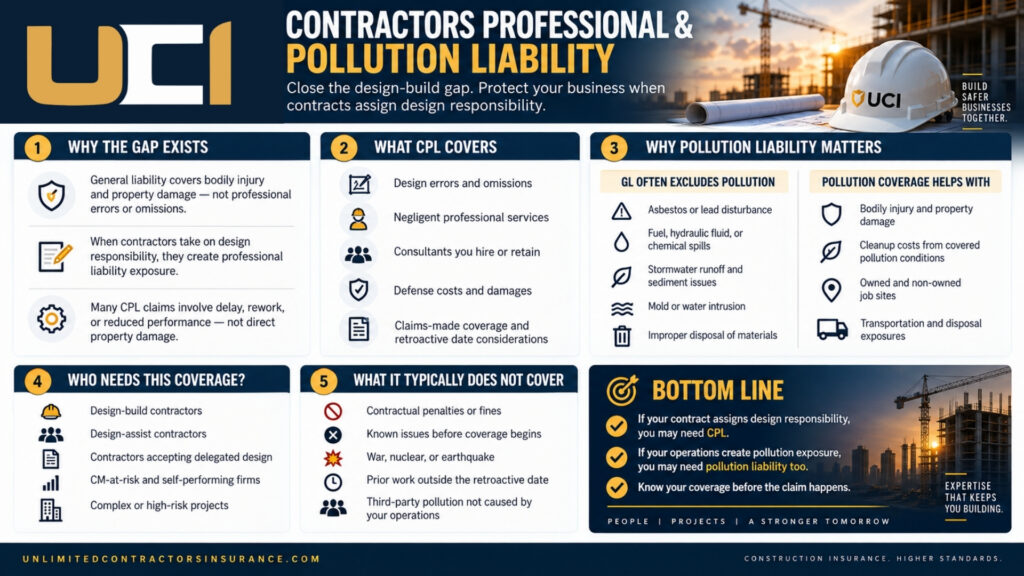
Your general liability policy covers bodily injury and property damage. It does not cover professional negligence.
That distinction rarely mattered when contractors built what architects designed. It matters enormously now, because delivery methods have changed. Design-build, design-assist, delegated design, and construction management at risk all place design responsibility on the contractor — and general liability was never written to respond to it.
The result is a coverage gap most contractors do not know they have. They accept design responsibility in a contract, perform the work competently, and discover only after a claim that the exposure sat outside every policy they carried.
This guide explains where the gap opens, what contractors professional liability covers, why pollution coverage usually travels alongside it, and how to tell whether you need it.
Why general liability leaves the gap
General liability responds to bodily injury and property damage caused by an occurrence. That framing creates two problems for design exposure.
Professional services exclusions. Most contractor GL policies exclude liability arising from professional services, including design, engineering, surveying, inspection, and related activities. The exclusion often reaches further than contractors expect.
No property damage requirement met. Many professional claims involve purely economic loss with no physical damage at all. A design error causing schedule delay, rework, or reduced system performance may produce no property damage in the policy’s sense, so GL never engages.
Consequently, a contractor can face a substantial claim arising from work they performed, with a policy that does not reach it.
Where design responsibility actually lands on contractors
Contractors frequently carry professional exposure without recognizing it. These are the common routes.
Design-build. You hold a single contract for both design and construction. Design liability sits squarely with you, even when you retain an architect or engineer to perform the work.
Delegated design. This is the most overlooked route. The design professional specifies performance criteria and delegates detailed design of specific systems to trade contractors. Common examples include structural steel connections, fire protection systems, curtain wall, precast, MEP coordination, and shoring.
If you engineer connections or design a sprinkler layout, you have performed professional services — whether or not anyone used the word “design” in your contract.
Design-assist. You participate in design development, offering constructability input and refining details. That participation can create liability even where the architect retains formal responsibility.
Means and methods. Temporary works, shoring, formwork, rigging, and excavation support all involve engineering judgment. Failures here produce professional claims.
Construction management. Scheduling, budgeting, coordination, and administration are professional services. A CM at risk or agency CM carries exposure regardless of whether they touch design.
Value engineering. Proposing substitutions and alternatives is a professional act. If a substitution underperforms, the proposal is where liability attaches.
What contractors professional liability covers
Contractors professional liability, sometimes called CPL, covers claims arising from actual or alleged negligence in professional services performed by you or on your behalf.
Coverage typically includes defense costs and damages for design errors and omissions, negligent performance of professional services, and — this matters — the acts of design consultants you retain. That last element is important, because your subconsultant’s error becomes your problem under a design-build contract.
Several structural features distinguish these policies from general liability.
They are written claims-made. Coverage responds to claims reported during the policy period, not to work performed during it. That makes the retroactive date critical.
Retroactive dates control your history. Work performed before the retroactive date is not covered. Changing carriers can reset it and erase coverage for prior years, so protect the date when you move markets.
Extended reporting periods matter. If you let coverage lapse or wind down the business, tail coverage preserves protection for past work. Without it, claims arriving later have no policy.
Defense costs usually erode limits. Professional claims are litigation-heavy and defense-intensive. On most CPL forms, defense spending reduces the limit available for settlement, which makes limit adequacy a more serious question than it first appears.
Why pollution coverage usually comes along
Contractors professional and pollution liability are frequently packaged together, and the pairing makes practical sense.
General liability policies exclude pollution broadly. Yet contractors create pollution exposure constantly through ordinary operations.
Common contractor pollution claims include disturbed asbestos or lead during renovation, silica dust migration, fuel and hydraulic fluid releases, damaged underground storage tanks or utility lines, sediment runoff and stormwater violations, mold from water intrusion, chemical spills, and improper disposal of construction materials.
Contractors pollution liability, or CPL in its pollution sense, covers bodily injury, property damage, and cleanup costs arising from pollution conditions caused by your operations.
Two coverage distinctions matter.
Owned versus non-owned sites. Most contractor policies focus on job sites where you work rather than property you own. Confirm which applies.
Transportation and disposal. Coverage for materials in transit and at disposal facilities is a separate consideration and frequently excluded. If you haul contaminated material, address it specifically.
Mold and legionella often receive separate treatment as well, sometimes sublimited or excluded, so confirm rather than assume.
The combined form
Many carriers write professional and pollution coverage on a single combined policy, often with a shared limit.
That structure has advantages. It removes gaps between two policies, avoids disputes about which one responds when a claim involves both — a design error that produces an environmental condition, for instance — and simplifies administration.
The shared limit is the trade-off. One large claim can consume capacity intended for both exposures. On projects with meaningful environmental risk, consider whether separate limits serve you better.
How to know whether you need it
Work through these questions honestly.
Does any contract you have signed assign design responsibility to you? Look for design-build language, delegated design provisions, performance specifications, and requirements that you engineer any element.
Do your subcontracts delegate design downstream? If so, your subs need professional coverage too, and your contract should require it.
Do you retain design professionals? Under design-build, their errors become your liability. Their own coverage may not protect you, and it may be inadequate for the project.
Do you perform CM services? Scheduling, coordination, and administration are professional services regardless of design involvement.
Do you engineer temporary works? Shoring, formwork, and rigging design carry engineering exposure.
Do you renovate existing buildings? Renovation is where pollution exposure concentrates — asbestos, lead, mold, and unknown site conditions.
Do owner contracts require it? Increasingly they do. Many design-build and CM agreements now mandate professional liability limits explicitly.
If more than one of these applies, the gap is real.
Practice policy or project-specific?
Both structures exist, and the choice mirrors the logic in project placements generally.
A practice policy covers your professional services across all projects, renews annually, and shares limits across your entire book of work.
A project-specific policy covers one project, typically with a longer reporting period reflecting that project’s exposure horizon.
Project-specific coverage makes sense when the contract requires limits above your practice program, when a single project represents concentrated exposure, or when the design exposure is unusual for your operations.
Many contractors carry a practice policy and add project placements where individual jobs demand more.
What contractors get wrong
Assuming the architect’s policy protects them. Under design-build, you hold the obligation to the owner. The architect’s coverage protects the architect.
Ignoring delegated design. This is the most common gap. Contractors performing connection design or system layout often do not recognize it as professional services until a claim arrives.
Letting retroactive dates reset. Switching carriers without protecting the retroactive date can eliminate coverage for years of completed work.
Undersized limits given eroding defense. Professional claims consume defense dollars heavily. A limit that appears adequate can be substantially depleted before any settlement.
Failing to require it downstream. If you delegate design to subs, require professional coverage from them with appropriate limits and reporting periods.
Assuming GL covers pollution. It generally does not, and the exclusion is broad.
Dropping coverage after a project ends. Claims-made coverage responds only while active. Design and pollution claims frequently surface years later.
Frequently asked questions
Does general liability cover design errors? No. Most contractor general liability policies exclude liability arising from professional services, including design. Many professional claims also involve purely economic loss without physical damage, which general liability does not address regardless of exclusions.
What is contractors professional liability? It is coverage for claims arising from actual or alleged negligence in professional services performed by a contractor or on its behalf, including design errors and omissions and the acts of retained design consultants. It is written on a claims-made basis.
What is delegated design and why does it matter? Delegated design occurs when the design professional specifies performance criteria and delegates detailed design of specific elements to trade contractors — steel connections, fire protection layout, curtain wall, shoring. It creates professional liability exposure for contractors who often do not recognize they are performing design services.
Do I need professional liability if I only do design-assist? Frequently yes. Participating in design development and offering constructability input can create liability even where the architect retains formal responsibility. Review your specific contract language with your broker and counsel.
What is contractors pollution liability? It covers bodily injury, property damage, and cleanup costs arising from pollution conditions caused by your operations — asbestos and lead disturbance, silica, fuel releases, sediment runoff, mold, and similar exposures that general liability excludes.
Why are professional and pollution coverage often combined? Because contractors face both exposures, and combined forms eliminate gaps and disputes about which policy responds when a claim involves both. The trade-off is that a shared limit can be consumed by a single large claim.
What is a retroactive date and why does it matter? On claims-made policies, the retroactive date establishes how far back covered work extends. Services performed before that date are not covered. Changing carriers can reset it, eliminating coverage for prior work, so the date should be protected when moving markets.
Does my design consultant’s insurance protect me? Not adequately in most cases. Under design-build, you hold the obligation to the owner, and your consultant’s policy protects your consultant. Their limits may also be insufficient for the project, which is why contractors carry their own coverage and require appropriate limits downstream.
Match the coverage to the delivery method
The design-build gap exists because contracting evolved faster than insurance buying habits did. Contractors took on design responsibility, and many kept the same coverage they carried when architects handled it.
The fix is straightforward once the exposure is recognized. Identify where your contracts assign design responsibility, including delegated design you may not have labeled as such. Confirm whether your current program excludes it. Then size professional and pollution coverage to the exposure, protect your retroactive date, and require matching coverage from subs you delegate design to.
If you perform design-build, CM at risk, or any delegated design, and you are not certain how your program handles it, that review is worth doing before your next award rather than after a claim.
This article is general information, not legal advice. Policy forms, exclusions, and contract language vary. Review your specific contracts and policies with your broker and legal counsel.