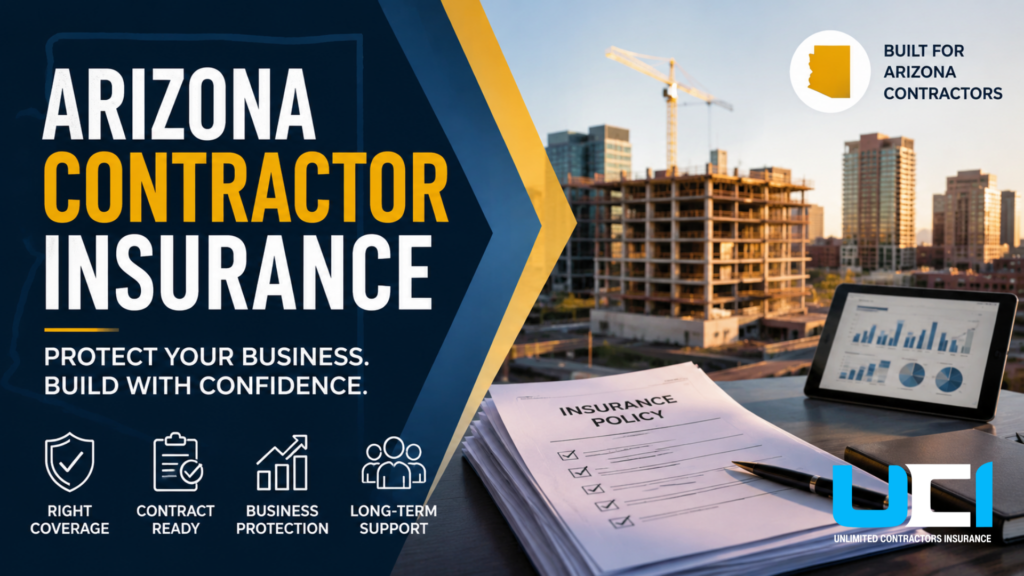
As your construction business grows, your insurance needs change. What worked when you were a smaller operation may not be enough once you’re managing larger projects, more employees, more subcontractors, and increasingly complex contract requirements.
For many Arizona contractors, insurance becomes more than a compliance requirement as revenue increases. It becomes a key part of protecting profitability, securing new work, and maintaining long-term stability. The difference between having a policy and having the right coverage structure can determine how well your business handles audits, claims, contract reviews, and unexpected challenges.
At Unlimited Contractors Insurance (UCI), we work with contractors across Arizona to help ensure their coverage aligns with how their business actually operates—not just what a standard policy provides.
If you’re unsure whether your current insurance program is keeping pace with your growth, now is the time to review it.
As Your Business Grows, So Does Your Risk
Many contractors assume that as long as their policy is active, they’re protected. In reality, growth often creates new exposures that existing coverage may not adequately address.
Larger projects typically come with stricter contract requirements, higher liability limits, additional insured provisions, waiver of subrogation requirements, and more detailed insurance compliance standards. At the same time, increased payroll, expanding vehicle fleets, and greater subcontractor involvement can significantly impact your risk profile.
The challenge is that many policies were originally designed for smaller operations and never properly adjusted as the company evolved.
This often leads to problems such as coverage that doesn’t match contractual requirements, unexpected workers’ compensation audit charges, gaps involving subcontractors, or endorsements that only become an issue after a claim has been filed.
Building a Strong Insurance Foundation
The goal isn’t necessarily to purchase more insurance. The goal is to ensure your coverage works together as a complete risk management strategy.
General liability coverage remains the foundation of most contractor insurance programs. However, the policy must be structured correctly to address completed operations, subcontractor exposure, and project-specific requirements. Missing endorsements or incorrectly structured coverage can create costly issues when contracts are reviewed or claims arise.
Workers’ compensation becomes increasingly important as payroll grows. Accurate employee classifications, proper recordkeeping, and proactive audit preparation can help prevent costly surprises while keeping premiums under control.
Commercial auto coverage should accurately reflect how vehicles are used within your operation. As companies grow, additional drivers, larger fleets, and increased jobsite activity can create exposures that basic policies may not fully address.
Builder’s risk coverage can play a critical role in protecting projects during construction by helping safeguard materials, equipment, and structures from theft, vandalism, weather events, and other covered losses before a project is complete.
For contractors involved in design-build work, consulting, project management, or professional services, professional liability coverage may provide important protection against claims involving errors, omissions, or professional advice.
Cyber liability has also become increasingly relevant as contractors rely more heavily on cloud-based software, digital project management systems, electronic payments, and client data storage. A cyber incident can disrupt operations and create significant financial exposure regardless of company size.
Why Focusing Only on Price Can Be Costly
Every contractor wants competitive insurance pricing. However, choosing coverage based solely on premium can create expensive problems later.
Some of the most common issues contractors face include workers’ compensation audit surprises, subcontractor compliance problems, missing endorsements, contract compliance failures, and coverage gaps that only become apparent when a claim occurs.
In many cases, the true cost isn’t the premium itself—it’s the disruption, lost opportunities, legal expenses, or uncovered losses that result from inadequate coverage.
The most effective insurance programs balance competitive pricing with proper protection, allowing contractors to pursue growth without exposing the business to unnecessary risk.
Understanding What Impacts Insurance Costs
Insurance premiums are influenced by several factors, including company revenue, payroll, project size, claims history, subcontractor usage, and the type of work being performed.
Contractors who maintain strong safety programs, keep accurate records, properly manage subcontractors, and demonstrate effective risk management practices often position themselves for better long-term pricing and carrier relationships.
Insurance companies generally reward businesses that operate proactively rather than reactively.
Common Coverage Gaps Contractors Overlook
Even well-established contractors can have blind spots within their insurance programs.
One of the most common issues involves assuming general liability covers every type of claim. In reality, professional services, certain contractual obligations, and work performed outside listed classifications may not be covered.
Many contractors also discover limitations related to subcontractor exposure, completed operations, or project-specific requirements only after a problem arises.
The key is identifying these gaps before they become expensive lessons.
When a Claim Happens
A claim is often the moment when the quality of your insurance program is truly tested.
Strong documentation, accurate reporting, well-maintained contracts, and properly structured coverage can significantly impact how smoothly a claim is handled. The more closely your policy aligns with your actual operations, the more likely it is to respond as expected when you need it most.
This is why periodic coverage reviews are so important, especially for growing construction companies.
Protecting Your Business as You Continue to Grow
As your company expands, your insurance strategy should evolve with it. Regular policy reviews, accurate employee classifications, proper subcontractor management, and ongoing risk assessments can help reduce costs while maintaining strong protection.
The objective isn’t simply to satisfy insurance requirements—it’s to create a coverage structure that supports your business goals, protects your assets, and helps position your company for long-term success.
Get a Free Coverage Review
Construction companies face enough challenges without worrying about whether their insurance program is properly structured.
At Unlimited Contractors Insurance, we specialize in helping contractors evaluate their coverage, identify potential gaps, and build insurance solutions designed specifically for the construction industry.
Because when your business is growing, having the right coverage isn’t just about meeting requirements—it’s about protecting everything you’ve worked to build.